A Natural Solution for California's Herds: African Catfish Peptides

California's cattle producers and agricultural communities are all too familiar with the rising challenge of antibiotic resistance, making common bacterial infections harder to treat in livestock. But imagine a future where we could tackle these infections with a natural, powerful alternative. Our research points to just that: antimicrobial peptides (AMPs) found in African catfish.

We're really excited about these peptides because African catfish thrive in pathogen-rich freshwater, naturally producing these robust immune compounds in their skin mucus as a defense. This natural origin makes them highly appealing alternatives to synthetic drugs.

Predicted Safety and Potent Action

One of the most compelling aspects of these AMPs is their predicted safety for mammals. Our initial computer analyses suggest that various catfish AMPs are generally recognized as safe (GRAS). We predict they'll be absorbed in the human intestine without causing liver, brain, or heart toxicity. Furthermore, lab tests on a promising peptide, NACAP-II, confirmed it was non-hemolytic, meaning it didn't damage rabbit red blood cells—a strong indicator of its potential safety for mammalian cells.

Beyond safety, these peptides demonstrate effectiveness against problematic bacteria. One study revealed NACAP-II's strong activity against Extended-Spectrum Beta-Lactamase (ESBL)-producing Escherichia coli—a critical concern for both animal and human health due to its resistance to many common antibiotics. Another peptide, ACAP-IV, also showed antibacterial activity against E. coli and Staphylococcus aureus. We believe these AMPs work by directly disrupting bacterial cell membranes, a mechanism that makes it harder for bacteria to develop resistance compared to how they resist traditional antibiotics.

Primary Image
COVID-19. Flu shot. Sleeve UP and get both updated vaccines as recommended to help protect yourself and your loved ones!
ANR Employee News: Article

Help promote COVID, flu vaccination

February 27, 2024
By Pamela S Kan-Rice
An informational campaign to raise awareness of COVID-19 and Influenza vaccination among migrant workers who speak Mexican indigenous languages has been created by Ricardo Vela, manager of News and Information Outreach in Spanish; Amira Resnick, statewide director of Community Nutrition and Health;...
View Article
Primary Image
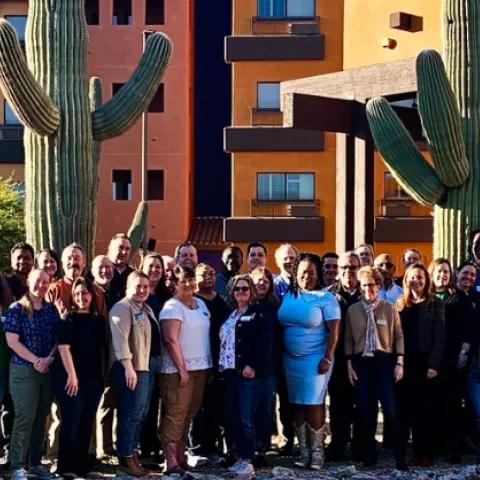
Group of people flanked by two large saguaro cacti.
ANR Employee News: Article

Extension professionals gather to form climate-action plan

February 27, 2024
By Pamela S Kan-Rice
More than 40 Cooperative Extension professionals from across the U.S. and outlying territories gathered recently in Tucson, Arizona, for Cooperative Extension's first national Climate Action Convening.
View Article
The Savvy Sage: Article

A Tribute to My Winter Mini Garden

February 27, 2024
Although Master Gardeners know better, many people focus on summer gardening, especially of tomatoes in Yolo County. However, I find my winter garden at least as useful as my summer one. This is partly because of how I approach it. My vegetable garden is in raised beds, with one foot redwood sides.
View Article
Tulare County Cooperative Extension: Article

Climate Smart Ag Meeting

February 27, 2024
WORKSHOP ON ADAPTING FRUIT AND NUT PRODUCTION PRACTICES IN THE SAN JOAQUIN VALLEY TO CHANGING AND VARIABLE CLIMATE Date: Thursday, March 7th, 2024; 8:30 am - 2:00 pm Location: International Agri-Center (Social Room) 4500 South Laspina Street - Tulare, CA 93274 With: UC Davis, UC Merced, UCCE Tulare...
View Article
Primary Image
Reported observations of Cape Ricegrass in California.
UC Weed Science (weed control, management, ecology, and minutia): Article

Wildland Weed Alert: Cape Ricegrass (Stipa capensis)

February 26, 2024
Keep an eye out for this potential problem weed in southern California: Stipa capensis. First reported in 1995 in Riverside, this species is native to the Mediterranean and has established in the Coachella Valley of the Sonoran Desert.
View Article