A Natural Solution for California's Herds: African Catfish Peptides

California's cattle producers and agricultural communities are all too familiar with the rising challenge of antibiotic resistance, making common bacterial infections harder to treat in livestock. But imagine a future where we could tackle these infections with a natural, powerful alternative. Our research points to just that: antimicrobial peptides (AMPs) found in African catfish.

We're really excited about these peptides because African catfish thrive in pathogen-rich freshwater, naturally producing these robust immune compounds in their skin mucus as a defense. This natural origin makes them highly appealing alternatives to synthetic drugs.

Predicted Safety and Potent Action

One of the most compelling aspects of these AMPs is their predicted safety for mammals. Our initial computer analyses suggest that various catfish AMPs are generally recognized as safe (GRAS). We predict they'll be absorbed in the human intestine without causing liver, brain, or heart toxicity. Furthermore, lab tests on a promising peptide, NACAP-II, confirmed it was non-hemolytic, meaning it didn't damage rabbit red blood cells—a strong indicator of its potential safety for mammalian cells.

Beyond safety, these peptides demonstrate effectiveness against problematic bacteria. One study revealed NACAP-II's strong activity against Extended-Spectrum Beta-Lactamase (ESBL)-producing Escherichia coli—a critical concern for both animal and human health due to its resistance to many common antibiotics. Another peptide, ACAP-IV, also showed antibacterial activity against E. coli and Staphylococcus aureus. We believe these AMPs work by directly disrupting bacterial cell membranes, a mechanism that makes it harder for bacteria to develop resistance compared to how they resist traditional antibiotics.
Primary Image
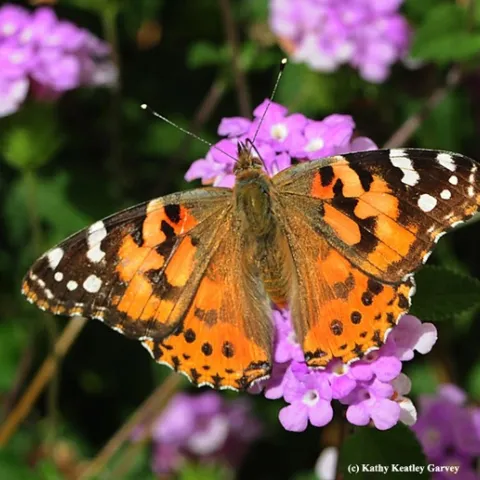
Art Shapiro saw 19 of this species, Pieris rapae, or cabbage white, today at his North Sacramento study site. (Photo by Kathy Keatley Garvey)
Bug Squad: Article

A Close Call

September 16, 2014
By Kathy Keatley Garvey
Butterfly expert Art Shapiro, distinguished professor of evolution and ecology at UC Davis, isn't feeling so well--to put it mildly--but he still went out on one of his butterfly monitoring expeditions today at his study site in North Sacramento.
View Article
Primary Image
A praying mantis perches on a cosmos. (Photo by Kathy Keatley Garvey)
Bug Squad: Article

Prayers Answered

September 12, 2014
By Kathy Keatley Garvey
Praying mantids are, oh, so patient. They perch on a flower, their spiked forelegs seemingly locked in a praying position, and wait to ambush unsuspecting prey. A green praying mantis recently did just that on our cosmos.
View Article
UC Weed Science (weed control, management, ecology, and minutia): Article

Spray Adjuvants: The Rest of the Story (reposted from CWSS)

September 12, 2014
By Brad Hanson
Dr. Rich Zollinger, a weed scientist from North Dakota State University, made a great presentation at the last CWSS meeting on spray adjuvants. He's a very knowledgeable (and fun) speaker and the team at NDSU has done some really great work on spray adjuvants and technology for decades.
View Article
Primary Image
The pink bollworm, a global pest of cotton, has evolved resistance to genetically modified cotton in India, but not in Arizona where farmers have planted refuges of conventional cotton to reduce selection for resistance. (Photo by Alex Yelich, University of Arizona)
Bug Squad: Article

Helping to Meet Global Challenges Through Evolutionary Biology

September 11, 2014
By Kathy Keatley Garvey
Two categories of evolutionary challenges result from escalating human impacts on the planet. The first arises from cancers, pathogens and pests that evolve too quickly, and the second from the inability of many valued species to adapt quickly enough.
View Article
Primary Image
This Anise Swallowtail is missing part of its wing. A predator missed. (Photo by Kathy Keatley Garvey)
Bug Squad: Article

Something Was Wrong

September 10, 2014
By Kathy Keatley Garvey
Something was wrong. The Anise Swallowtail (Papillo zelicaon) that fluttered into our bee garden last weekend and began nectaring on zinnia wasn't quite herself. Her yellow and black coloring and the striking blue spot on the rear left wing looked fine.
View Article
Primary Image
Praying mantis eats a honey bee while a freeloader fly, family Milichilidae, does, too. Another freeloader edges closer. (Photo by Kathy Keatley Garvey)
Bug Squad: Article

Brother, Can You Spare a Meal?

September 9, 2014
By Kathy Keatley Garvey
A freeloader. A moocher. A sponger. That's the freeloader fly. A praying mantis is polishing off the remains of a honey bee. Suddenly a black dot with wings edges closer and closer and grabs a bit of the prey. So tiny. So persistent. So relentless. That's the freeloader fly.
View Article
Primary Image
image 24590
IGIS: Article

Meadow fire update, burning in Little Yosemite Valley

September 9, 2014
By Maggi Kelly
It's not yet on Inciweb, but the Meadow fire is burning near Yosemite, at the east of Little Yosemite Valley. They say: "This is not a CAL FIRE incident." Yosemite NP says as of today: "Meadow (37 42.738 x 119 30.541 Mariposa Co.
View Article
Primary Image
sdhogan
IGIS: Article

IGIS Welcomes Sean Hogan to the Team

September 9, 2014
By Shane T Feirer
Sean Hogan joined UCANR and IGIS on September 2, 2014 as an Academic Coordinator II, to provide IGIS analysis, coordination and support to the Informatics and Geographic Information Systems (IGIS) team to the meet the IGIS mission. Sean has a double major B.A.
View Article