A Natural Solution for California's Herds: African Catfish Peptides

California's cattle producers and agricultural communities are all too familiar with the rising challenge of antibiotic resistance, making common bacterial infections harder to treat in livestock. But imagine a future where we could tackle these infections with a natural, powerful alternative. Our research points to just that: antimicrobial peptides (AMPs) found in African catfish.

We're really excited about these peptides because African catfish thrive in pathogen-rich freshwater, naturally producing these robust immune compounds in their skin mucus as a defense. This natural origin makes them highly appealing alternatives to synthetic drugs.

Predicted Safety and Potent Action

One of the most compelling aspects of these AMPs is their predicted safety for mammals. Our initial computer analyses suggest that various catfish AMPs are generally recognized as safe (GRAS). We predict they'll be absorbed in the human intestine without causing liver, brain, or heart toxicity. Furthermore, lab tests on a promising peptide, NACAP-II, confirmed it was non-hemolytic, meaning it didn't damage rabbit red blood cells—a strong indicator of its potential safety for mammalian cells.

Beyond safety, these peptides demonstrate effectiveness against problematic bacteria. One study revealed NACAP-II's strong activity against Extended-Spectrum Beta-Lactamase (ESBL)-producing Escherichia coli—a critical concern for both animal and human health due to its resistance to many common antibiotics. Another peptide, ACAP-IV, also showed antibacterial activity against E. coli and Staphylococcus aureus. We believe these AMPs work by directly disrupting bacterial cell membranes, a mechanism that makes it harder for bacteria to develop resistance compared to how they resist traditional antibiotics.
Primary Image
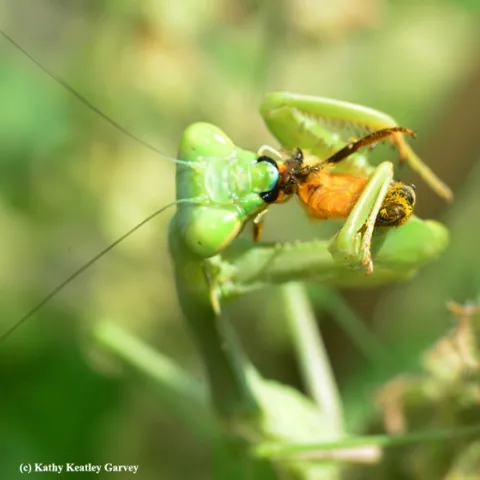
A Valley carpenter bee receives a brush of pollen. (Photo by Kathy Keatley Garvey)
Bug Squad: Article

Pollen Power

May 15, 2014
By Kathy Keatley Garvey
Female Valley carpenter bees are solid black--except when they're foraging around passion flowers. Then they're black and yellow--the yellow being the color of the pollen transferred to their thorax. Beautiful? Absolutely.
View Article
Primary Image
Strawberry pesticide use-2012b
E-Journal of Entomology and Biologicals: Article

Pesticide use in California strawberries

May 15, 2014
Western tarnished plant bug (Lygus hesperus), also known as lygus bug, is a major pest of strawberries in California. Ideal environmental conditions and the diversity and abundance of crop and weed hosts that support the pest contributed to its increasing populations.
View Article
Primary Image
Spider mites on strawberries
E-Journal of Entomology and Biologicals: Article

Managing spider mites in California strawberries

May 14, 2014
Strawberry field with spider mite infestation. Plants in the lower part of the photo are stunted due to twospotted spider mite damage (Photo by Surendra Dara) Multiple species of spider mites infest strawberries in California.
View Article
UC Weed Science (weed control, management, ecology, and minutia): Article

Weed control in cilantro and parsley

May 14, 2014
By Richard F Smith
From the UC Cooperative Extension Monterey County Crop Notes newsletter (March/April 2014) Excellent weed control is essential for economically producing cilantro and parsley. Both crops have had various weed control challenges over the last few years.
View Article
Primary Image
foamy bark oak
Topics in Subtropics: Article

Decline of Coast Live Oak Trees in Southern California Is Due to Fungus

May 14, 2014
By Ben A Faber
We've been getting reports of coast live oak decline along the coast, well, here's one of the causes: RIVERSIDE, Calif. A fungus associated with the western oak bark beetle is causing a decline in coast live oak trees in Southern California by spreading foamy bark canker disease.
View Article
Primary Image
A bee ballet over a Matilija poppy. (Photo by Kathy Keatley Garvey)
Bug Squad: Article

Bee Ballet Over Matilija Poppy

May 13, 2014
By Kathy Keatley Garvey
Whenever you look at the Matilija poppy, you think of a fried egg. White, crepelike flowers (the egg whites) circle a cluster of gold stamens (the yolk).
View Article
Primary Image
uneven peach bloom
Topics in Subtropics: Article

An Unusual Spring

May 13, 2014
By Ben A Faber
We had a pretty mild winter, in spite of the freeze damage that occurred in the Central Valley. Now we are seeing what happens when there's not enough chilling to break bud. There is erratic flowering and leaf out. This can be quite pronounced in such trees as peach and apricots, apples and pears.
View Article
Primary Image
Gulf Fritillary touches down on a blanket flower. (Photo by Kathy Keatley Garvey)
Bug Squad: Article

Made for Each Other

May 12, 2014
By Kathy Keatley Garvey
What a perfect match when a Gulf Fritillary butterfly touches down on a blanket flower. They're both reddish-orange and showy. Last weekend we spotted a Gulf Fritillary butterfly (Agraulis vanillae) land momentarily on a blanket flower (Gaillardia), in our bee garden.
View Article
IGIS: Article

Breakthroughs article on SNAMP: Taming the flames

May 11, 2014
By Maggi Kelly
Despite some not-very-flattering-but-taken-with-really-rad-tintype-photography pictures of us all, this is an interesting article that focuses on our public participation in the SNAMP project. Check it out! http://cnr.berkeley.
View Article