A Natural Solution for California's Herds: African Catfish Peptides

California's cattle producers and agricultural communities are all too familiar with the rising challenge of antibiotic resistance, making common bacterial infections harder to treat in livestock. But imagine a future where we could tackle these infections with a natural, powerful alternative. Our research points to just that: antimicrobial peptides (AMPs) found in African catfish.

We're really excited about these peptides because African catfish thrive in pathogen-rich freshwater, naturally producing these robust immune compounds in their skin mucus as a defense. This natural origin makes them highly appealing alternatives to synthetic drugs.

Predicted Safety and Potent Action

One of the most compelling aspects of these AMPs is their predicted safety for mammals. Our initial computer analyses suggest that various catfish AMPs are generally recognized as safe (GRAS). We predict they'll be absorbed in the human intestine without causing liver, brain, or heart toxicity. Furthermore, lab tests on a promising peptide, NACAP-II, confirmed it was non-hemolytic, meaning it didn't damage rabbit red blood cells—a strong indicator of its potential safety for mammalian cells.

Beyond safety, these peptides demonstrate effectiveness against problematic bacteria. One study revealed NACAP-II's strong activity against Extended-Spectrum Beta-Lactamase (ESBL)-producing Escherichia coli—a critical concern for both animal and human health due to its resistance to many common antibiotics. Another peptide, ACAP-IV, also showed antibacterial activity against E. coli and Staphylococcus aureus. We believe these AMPs work by directly disrupting bacterial cell membranes, a mechanism that makes it harder for bacteria to develop resistance compared to how they resist traditional antibiotics.
Colusa County: Article

February 2014

February 3, 2014
Colusa Farm Show February 4,5,6 Lots of good gardening information at the Farm Show Remember to stop by and see the UC Master Gardeners of Colusa County in the Main Exhibit Hall.
View Article
Primary Image
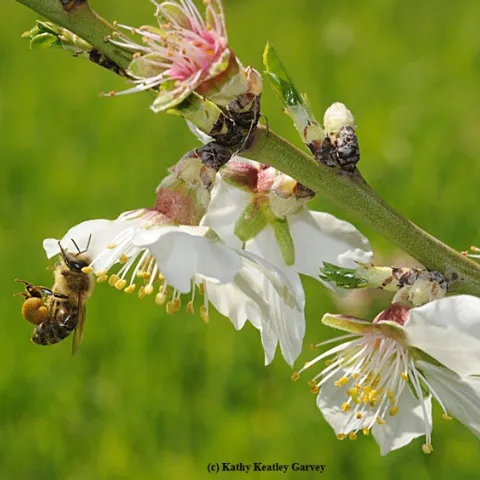
Honey bee packing pollen on an almond tree at UC Davis--on the grounds of the Harry H. Laidlaw Jr. Honey Bee Research Facility--several years ago. (Photo by Kathy Keatley Garvey)

About that Pollen...

January 31, 2014
By Kathy Keatley Garvey
Why is that in a honey bee colony, workers can carry pollen but not the queen? Well, scientists from Michigan State University and Wayne State University have discovered the answer.
View Article
Primary Image
Downy mildew 2
Pest News: Article

Downy mildew of clobbers impatiens

January 31, 2014
Early symptoms of downy mildew - stunted growth and yellowing compared to healthy leaf (right). (Photo by Margery Daughtrey, Cornell University) One of California's most adored flowering plants, impatiens, is being threatened by a serious pest.
View Article
Primary Image
avocado grove
Topics in Subtropics: Article

What's Going on in the Avocado Industry

January 31, 2014
By Ben A Faber
NOTES FROM CAC MEETING January 30, 2014 President's Report (Tom Bellamore) 2013 crop was 2nd highest total dollar return ($ 435,000,000 with 500,000,000 lbs = $ .
View Article
Colusa County: Article

February 2014

January 31, 2014
4-H Uniform Contest rules and details, Beef Ambassador Contest, Presentation Day and Home Ec Review deadline, Fair Logo Contest...
View Article
IGIS: Article

Cal Forestry turns 100 this year!

January 31, 2014
By Maggi Kelly
Forestry education at UC Berkeley began in 1914 with the Division of Forestry in the Department of Agriculture. The Department of Forestry was established in 1939 and the School of Forestry in 1946.
View Article
Primary Image
Pipevine Swallowtail, Battis philenor, nectaring on radish on Gates Canyon Road, Vacaville. (Photo by Kathy Keatley Garvey)

'Battus philenor! Battus philenor!'

January 30, 2014
By Kathy Keatley Garvey
Battus philenor! Battus philenor! Butterfly expert Art Shapiro, distinguished professor of evolution and ecology, excitedly points to a Pipevine Swallowtail nectaring on roadside radish.
View Article
Cooperative Extension Ventura County: Article

February 2014 CloverLines

January 30, 2014
In this issue... Presentations, Scholarship Opportunities, Plug into 4-H Through Social Media, New Leader Trainings and much more...
View Article