A Natural Solution for California's Herds: African Catfish Peptides

California's cattle producers and agricultural communities are all too familiar with the rising challenge of antibiotic resistance, making common bacterial infections harder to treat in livestock. But imagine a future where we could tackle these infections with a natural, powerful alternative. Our research points to just that: antimicrobial peptides (AMPs) found in African catfish.

We're really excited about these peptides because African catfish thrive in pathogen-rich freshwater, naturally producing these robust immune compounds in their skin mucus as a defense. This natural origin makes them highly appealing alternatives to synthetic drugs.

Predicted Safety and Potent Action

One of the most compelling aspects of these AMPs is their predicted safety for mammals. Our initial computer analyses suggest that various catfish AMPs are generally recognized as safe (GRAS). We predict they'll be absorbed in the human intestine without causing liver, brain, or heart toxicity. Furthermore, lab tests on a promising peptide, NACAP-II, confirmed it was non-hemolytic, meaning it didn't damage rabbit red blood cells—a strong indicator of its potential safety for mammalian cells.

Beyond safety, these peptides demonstrate effectiveness against problematic bacteria. One study revealed NACAP-II's strong activity against Extended-Spectrum Beta-Lactamase (ESBL)-producing Escherichia coli—a critical concern for both animal and human health due to its resistance to many common antibiotics. Another peptide, ACAP-IV, also showed antibacterial activity against E. coli and Staphylococcus aureus. We believe these AMPs work by directly disrupting bacterial cell membranes, a mechanism that makes it harder for bacteria to develop resistance compared to how they resist traditional antibiotics.
Primary Image
avocado
Topics in Subtropics: Article

Avocado Meetings

December 4, 2013
By Ben A Faber
Growing Avocados on Different Spacing SLO 2/4/14 @ Extension Office 1-3 p.m. Ventura 2/5/14 @ Extension Office 9-11 a.m. Fallbrook 2/6/14 @ Fallbrook Public Utility District 9-11 a.m. High Density in the Field and Uniconazole SLO 4/1/14 T.B.A. 1-3 p.m. Ventura 4/2/14 T.B.A. 9-11 a.m.
View Article
Primary Image
Asian soybean aphid. (Courtesy Wikipedia, Claudio Gratton, University of Wisconsin)

Targeting the Asian Soybean Aphid

December 3, 2013
By Kathy Keatley Garvey
The Asian soybean aphid is not exactly a household word. As its name implies, it's native to Asia. It was first detected in North America in Wisconsin in July 2000. Technically, its Aphis glycines Matsumura. In lay language, that's spelled "p-e-s-t.
View Article
Primary Image
A jeweled beetle, part of the arts and crafts activity. (Photo by Kathy Keatley Garvey)

The Beetles and the Sticks

December 2, 2013
By Kathy Keatley Garvey
Ooh, a walking stick! Look! Its eating a leaf. Ooh, look at the dung beetles. Those were some of the comments overheard at the Bohart Museum of Entomologys recent open house, themed Beauty and the Beetles.
View Article
Primary Image
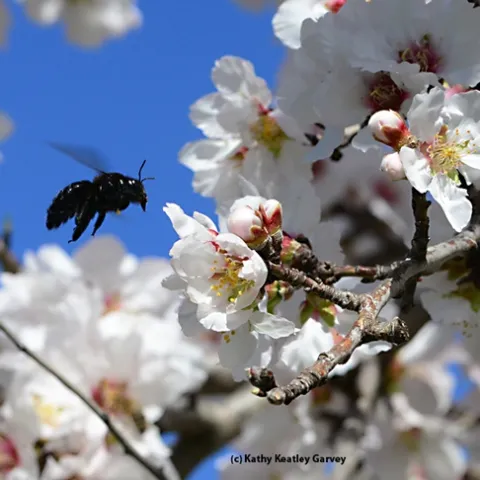
bumblebee
Topics in Subtropics: Article

Native Pollinators of Avocado

December 2, 2013
By Ben A Faber
Dr. Gordon Frankie at UC Berkeley is teaming with me in Ventura County to jointly work on a pollination study for avocados. Dr. Frankie is studying how to increase native bee pollinators in avocado orchards.
View Article
Primary Image
Butterfly expert Art Shapiro of UC Davis. (Photo by Kathy Keatley Garvey)

Linking Art with Science

November 29, 2013
By Kathy Keatley Garvey
So, you want to know more about butterflies and art, and the link between art and science. Youre in luck.
View Article
Primary Image
A honey bee heading for a tower of jewels, Echium wildpretii. (Photo by Kathy Keatley Garvey)

Thankful for Insects

November 28, 2013
By Kathy Keatley Garvey
Of the many things I'm thankful for on this Thanksgiving Day, I am thankful for the millions of insects that populate our planet. Scientists have described more than a million species, but there may be 10 million more undescribed. I am thankful for honey bees.
View Article
Primary Image
image 19567
IGIS: Article

Those crowded skies: Flight maps and delays

November 28, 2013
By Maggi Kelly
real time map of flights from planefinder.netYou've probably seen the frequently-cited "Misery Map" (D3 behind the scenes) showing how the Thanksgiving storm has blown many a tight travel plan off schedule. Here is another cool one: real-time map of all the flights in the air.
View Article
Primary Image
Spotted cucumber beetle and its path of destruction. (Photo by Kathy Keatley Garvey)

The Diabolical Diabrotica

November 27, 2013
By Kathy Keatley Garvey
Some folks mistake the spotted cucumber beetle for a ladybug or lady beetle. However, unlike the beneficial ladybug, which devours aphids and other soft-bodied insects, the spotted cucumber beetle is a major agricultural pest.
View Article
UC Weed Science (weed control, management, ecology, and minutia): Article

REPOST: Clarification on the use of Chateau (flumioxazin) prior to strawberry transplanting

November 27, 2013
By Brad Hanson
Reposted (with permission) from the Strawberries and Caneberries UC ANR blog Link to original post (October 11, 2013): Clarification on the Use of Chateau (flumioxazin) prior to Strawberry Transplanting written by Oleg Daugovish, Steve Fennimore, and Mark Bolda Great post Mark! Brad A response to th...
View Article