A Natural Solution for California's Herds: African Catfish Peptides

California's cattle producers and agricultural communities are all too familiar with the rising challenge of antibiotic resistance, making common bacterial infections harder to treat in livestock. But imagine a future where we could tackle these infections with a natural, powerful alternative. Our research points to just that: antimicrobial peptides (AMPs) found in African catfish.

We're really excited about these peptides because African catfish thrive in pathogen-rich freshwater, naturally producing these robust immune compounds in their skin mucus as a defense. This natural origin makes them highly appealing alternatives to synthetic drugs.

Predicted Safety and Potent Action

One of the most compelling aspects of these AMPs is their predicted safety for mammals. Our initial computer analyses suggest that various catfish AMPs are generally recognized as safe (GRAS). We predict they'll be absorbed in the human intestine without causing liver, brain, or heart toxicity. Furthermore, lab tests on a promising peptide, NACAP-II, confirmed it was non-hemolytic, meaning it didn't damage rabbit red blood cells—a strong indicator of its potential safety for mammalian cells.

Beyond safety, these peptides demonstrate effectiveness against problematic bacteria. One study revealed NACAP-II's strong activity against Extended-Spectrum Beta-Lactamase (ESBL)-producing Escherichia coli—a critical concern for both animal and human health due to its resistance to many common antibiotics. Another peptide, ACAP-IV, also showed antibacterial activity against E. coli and Staphylococcus aureus. We believe these AMPs work by directly disrupting bacterial cell membranes, a mechanism that makes it harder for bacteria to develop resistance compared to how they resist traditional antibiotics.
Primary Image
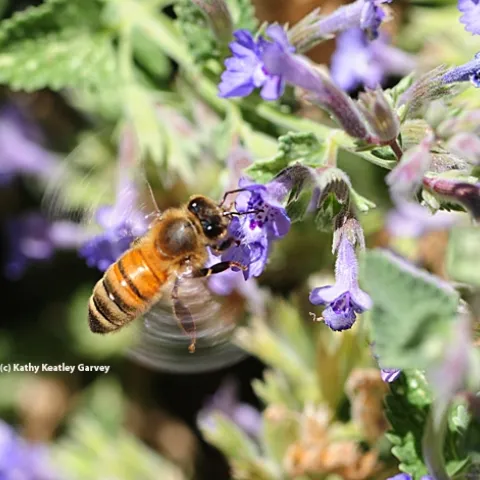
Honey bee greets a Spanish lavender blossom. (Photo by Kathy Keatley Garvey)

Dancing the Flamenco

March 25, 2013
By Kathy Keatley Garvey
One of TV's popular programs is "Dancing with Stars." The reality show pairs celebrities with professional ballroom dancers in a competition to win the mirror-ball trophy.
View Article
Cooperative Extension Ventura County: Article

Vol. 11, No. 1, March 2013

March 25, 2013
In this issue: Costs of Orchard Establishment and Production Summary for Avocados in California Huanglongbing Conference, Florida Going Out of Business in the Citrus Business -- Doing it the Right Way The Avocado: Botany, Production and Used, 2nd Edition Winter Irrigation Update from Israel on the P...
View Article
UC Weed Science (weed control, management, ecology, and minutia): Article

Life after MSMA

March 25, 2013
By Cheryl A Wilen
MSMA is an old herbicide that was sold for both the professional market for postemergence broadleaf and some grasses control in turf. It was also available in the home use market primarily for crabgrass management.
View Article
Primary Image
Mediterranean Fruit Fly. (Photo by Jack Kelly Clark)

The Invasion of Tropical Fruit Flies

March 22, 2013
By Kathy Keatley Garvey
From a trickle to a flood. But why? Professor James R. Carey of the UC Davis Department of Entomology will tell you why. He will discuss the invasion of tropical fruit flies in California at his seminar from 12:05 to 1 p.m.
View Article
Primary Image
Ladybugs mating; the female continues to munch aphids. (Photo by Kathy Keatley Garvey)

Sure Sign of Spring

March 21, 2013
By Kathy Keatley Garvey
What's red and black with yellow all over? Ladybugs, aka lady beetles or ladybird beetles, laying their yellow eggs. It's a sure sign of spring when aphids emerge, and ladybugs feast on them. One ladybug can reportedly eat 5000 aphids in its lifetime.
View Article
Primary Image
ACP adult and nymph
Topics in Subtropics: Article

Perfect Weather for ACP Scouting

March 21, 2013
By Ben A Faber
The weather is perfect for looking for Asian Citrus Psyllid. There is new flush and that is where the adults go to lay their eggs and feed. This is also the tissue where aphids and scale crawlers will be found, as well.
View Article
Primary Image
HLB citrus
Topics in Subtropics: Article

Electronic “sniffer” for determining HLB

March 21, 2013
By Ben A Faber
At a recent conference on Postharvest Technology Advances, Cristina Davis from the UC Davis Department of Mechanical and Aerospace Engineering presented information on the development of a device that can smell out trees infected with Huanglongbing (HLB).
View Article
Primary Image
Israel 1A
Topics in Subtropics: Article

Update from Israel

March 21, 2013
By Ben A Faber
Over the last two weeks Mary Lu Arpaia (Extension Specialist, UC Riverside) and David Obenland (Plant Physiologist, USDA-ARS) had the opportunity to visit Israel and spend several days looking at avocados including a visit with Zvi Mendel and Stanley Freeman, the lead researchers in Israel on the Po...
View Article