A Natural Solution for California's Herds: African Catfish Peptides

California's cattle producers and agricultural communities are all too familiar with the rising challenge of antibiotic resistance, making common bacterial infections harder to treat in livestock. But imagine a future where we could tackle these infections with a natural, powerful alternative. Our research points to just that: antimicrobial peptides (AMPs) found in African catfish.

We're really excited about these peptides because African catfish thrive in pathogen-rich freshwater, naturally producing these robust immune compounds in their skin mucus as a defense. This natural origin makes them highly appealing alternatives to synthetic drugs.

Predicted Safety and Potent Action

One of the most compelling aspects of these AMPs is their predicted safety for mammals. Our initial computer analyses suggest that various catfish AMPs are generally recognized as safe (GRAS). We predict they'll be absorbed in the human intestine without causing liver, brain, or heart toxicity. Furthermore, lab tests on a promising peptide, NACAP-II, confirmed it was non-hemolytic, meaning it didn't damage rabbit red blood cells—a strong indicator of its potential safety for mammalian cells.

Beyond safety, these peptides demonstrate effectiveness against problematic bacteria. One study revealed NACAP-II's strong activity against Extended-Spectrum Beta-Lactamase (ESBL)-producing Escherichia coli—a critical concern for both animal and human health due to its resistance to many common antibiotics. Another peptide, ACAP-IV, also showed antibacterial activity against E. coli and Staphylococcus aureus. We believe these AMPs work by directly disrupting bacterial cell membranes, a mechanism that makes it harder for bacteria to develop resistance compared to how they resist traditional antibiotics.
Primary Image
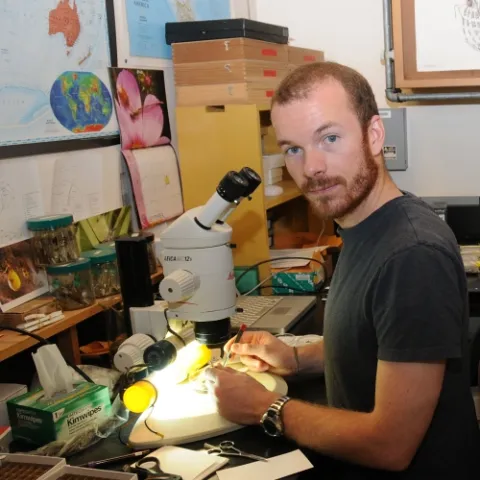
PESIDENT'S PRIZE--Michael Branstetter, a doctoral candidate in entomology at the University of California, Davis, won a coveted President's Prize for his presentation on ants at the Entomological Society of America's 56th annual meeting, held Nov. 16-19 in Reno. His major professor is Phil Ward. (Photo by Kathy Keatley Garvey)
Bug Squad: Article

President's Prize

November 20, 2008
By Kathy Keatley Garvey
He knows his ants. Michael Branstetter, a doctoral candidate in entomology at the University of California, Davis, won a coveted Presidents Prize for his oral presentation on ants at the 56th annual Entomological Society of America (ESA) meeting in Reno.
View Article
Primary Image
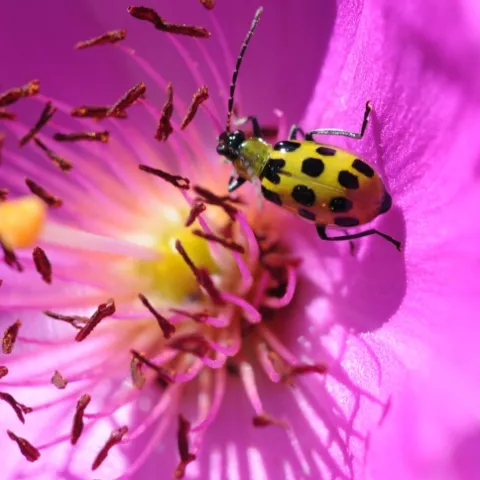
SPOTTED CUCUMBER BEETLE--A spotted cucumber beetle on a rock purslane. (Photo by Kathy Keatley Garvey)
Bug Squad: Article

Sideways

November 19, 2008
By Kathy Keatley Garvey
The movie, "Sideways," has nothing on a spotted cucumber beetle climbing up, down and sideways on a rock purslane. The spotted cucumber beetle is a pest, while the rock purslane has to be among the world's most beautiful flowers. (And also very attractive to insects.
View Article
Primary Image
LINNAEAN GAMES MODERATOR--Purdue entomology professor Tom Turpin moderates the annual Linnaean Games, part of the Entomological Society of America's annual meeting. (Photo by Kathy Keatley Garvey)
Bug Squad: Article

Let the Games Begin

November 18, 2008
By Kathy Keatley Garvey
Quick! Name three states that have no official state insect. That was one of the questions at the Linnaean Games, a traditional part of the Entomological Society of America's annual meeting. This year's meeting, the 56th annual, is now under way in Reno. The Linnaean Games have begun.
View Article
Primary Image
SPOTTED CUCUMBER BEETLE--A spotted cucumber beetle feeds on nectar in a rock purslane. (Photo by Kathy Keatley Garvey)
Bug Squad: Article

The Meeting

November 17, 2008
By Kathy Keatley Garvey
Last Saturday the rock purslane in our bee friendly garden drew a honey bee, several hover flies and one spotted cucumber beetle. A hover fly landed on a blossom, only to find a spotted cucumber beetle there first.
View Article
Primary Image
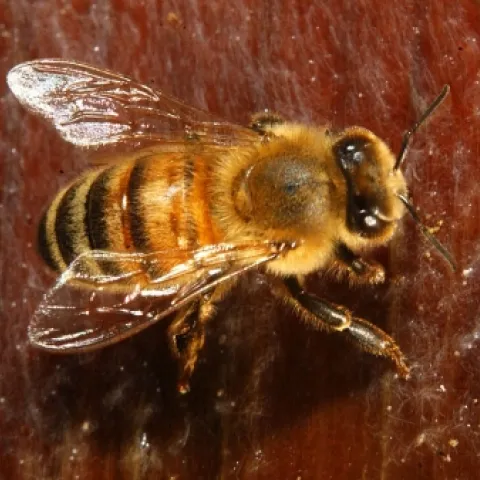
HONEY BEE--Close-up shot of a honey bee at the Harry Laidlaw Jr. Honey Bee Research Facility at UC Davis. (Photo by Kathy Keatley Garvey)
Bug Squad: Article

Honey of a Color

November 14, 2008
By Kathy Keatley Garvey
Honey isn't always amber-colored. It can range from white to dark brown, depending on the flowers the bees visit. Back in 1971, a group of UC Davis bee specialists wrote a booklet, Fundamentals of California Beekeeping, published by the "University of California College of Agriculture.
View Article
Primary Image
FRANK ZALOM--UC Davis professor Frank Zalom, an integrated pest management specialist, will be inducted as a Fellow in the Entomological Society of America on Sunday, Nov. 16 at its plenary session. At the same session, he will be honored as part of the UC's seven-member Almond Pest Management Alliance Integrated Pest Management (IPM) Team that will receive the Entomological Foundation’s 2008 Award for Excellence in IPM. Other team members are Carolyn Pickel, UC Cooperative Extension, Sutter-Yuba counties
Bug Squad: Article

A Gathering of Entomologists

November 13, 2008
By Kathy Keatley Garvey
When the Entomological Society of America's 56th annual meeting takes place Nov. 16-19 in Reno, UC Davis entomologists will be out in force. And they'll be highly honored.
View Article
Primary Image
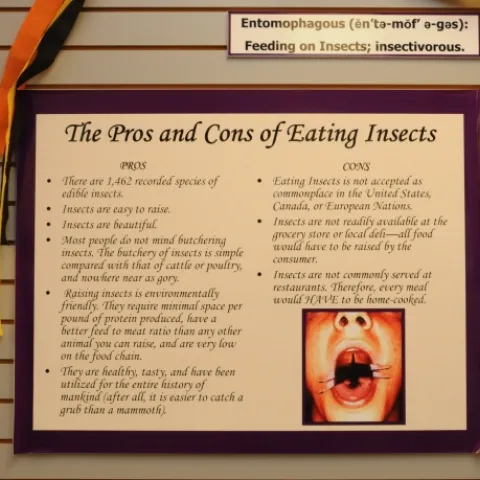
SIGN SAYS IT ALL--This sign at the Bohart Museum of Entomology offers the pros and cons of eating insects. (Photo by Kathy Keatley Garvey)
Bug Squad: Article

I Did Not Want to Know That

November 12, 2008
By Kathy Keatley Garvey
You may not know it, but you've eaten insects. Oh, yes, you have. The other day I meandered over to the Bohart Museum of Entomology, UC Davis campus, and a sign told me that. There it was--plain as day (as if a day can be plain).
View Article
Primary Image
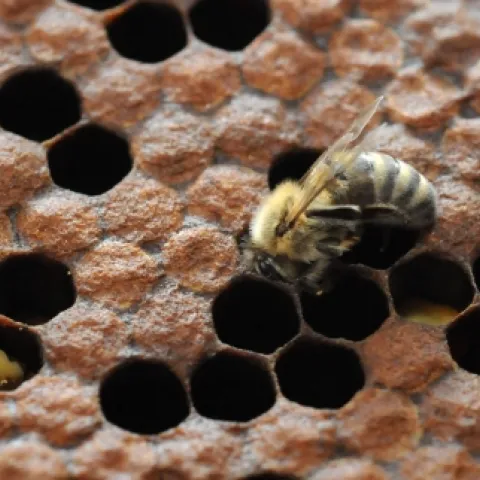
NEWLY EMERGED--A newborn bee struggles to right herself. Note the swath of yellow hair on her thorax. As she ages, the thorax will be smooth and mostly devoid of hair. (Photo by Kathy Keatley Garvey)
Bug Squad: Article

Fuzzy Wuzzy Was a Bee

November 11, 2008
By Kathy Keatley Garvey
It's Tuesday, Nov. 11, Veterans' Day. I walked into our bee friendly garden hoping to find a honey bee. One buzzed erratically over the purple sage and rock purslane and disappeared. The rest are nestled in a hive somewhere, trying to ward off the cold.
View Article
Primary Image
IN SUPPORT OF URBAN BEE DIVERSITY--Jaime Pawelek of UC Berkeley’s Department of Organisms and the Environment, discussed “Native California Bees: Looking for Cheap Urban Real Estate” at the Nov. 6 meeting of the Northern California Entomology Society. (Photo by Kathy Keatley Garvey)
Bug Squad: Article

Looking for Cheap Urban Real Estate

November 10, 2008
By Kathy Keatley Garvey
Chances are if you walked up to a group of people and asked "Have you seen a Megachile today?" they'd stare at you blankly. What's a Megachile? It's a native bee, also known as a leafcutter bee. When most people think about bees, they think about honey bees, which are native to Europe.
View Article
Primary Image
PRESENTATION--Entomologist William Roltsch of the California Department of Food and Agriculture discusses the light brown apple moth at the Nov. 6th meeting of the Northern California Entomology Society. (Photo by Kathy Keatley Garvey)
Bug Squad: Article

Good Question

November 7, 2008
By Kathy Keatley Garvey
Most entomologists I know maintain a keen sense of humor.
View Article