A Natural Solution for California's Herds: African Catfish Peptides

California's cattle producers and agricultural communities are all too familiar with the rising challenge of antibiotic resistance, making common bacterial infections harder to treat in livestock. But imagine a future where we could tackle these infections with a natural, powerful alternative. Our research points to just that: antimicrobial peptides (AMPs) found in African catfish.

We're really excited about these peptides because African catfish thrive in pathogen-rich freshwater, naturally producing these robust immune compounds in their skin mucus as a defense. This natural origin makes them highly appealing alternatives to synthetic drugs.

Predicted Safety and Potent Action

One of the most compelling aspects of these AMPs is their predicted safety for mammals. Our initial computer analyses suggest that various catfish AMPs are generally recognized as safe (GRAS). We predict they'll be absorbed in the human intestine without causing liver, brain, or heart toxicity. Furthermore, lab tests on a promising peptide, NACAP-II, confirmed it was non-hemolytic, meaning it didn't damage rabbit red blood cells—a strong indicator of its potential safety for mammalian cells.

Beyond safety, these peptides demonstrate effectiveness against problematic bacteria. One study revealed NACAP-II's strong activity against Extended-Spectrum Beta-Lactamase (ESBL)-producing Escherichia coli—a critical concern for both animal and human health due to its resistance to many common antibiotics. Another peptide, ACAP-IV, also showed antibacterial activity against E. coli and Staphylococcus aureus. We believe these AMPs work by directly disrupting bacterial cell membranes, a mechanism that makes it harder for bacteria to develop resistance compared to how they resist traditional antibiotics.
Primary Image
A drone (front) starts his takeoff to find a virgin queen. At left is a worker bee, his sister. Drones don't survive the winter; the girls kick the boys out of the hive.(Photo by Kathy Keatley Garvey)

Oh, Brother, Where Art Thou?

September 22, 2008
It's tough being a drone honey bee this time of year. The drones, or male bees, don't survive the winter. Bee breeder-geneticist Susan Cobey of the Harry H. Laidlaw Jr. Honey Bee Research Facility at UC Davis admits to having a soft spot for drones.
View Article
Primary Image
A Consperse stink bug (Euschistus conspersus) races down a post at the Harry H. Laidlaw Jr. Honey Bee Research Facility, UC Davis campus. Note its distinctive shield shape and its five-segmented antennae. (Photo by Kathy Keatley Garvey)
Bug Squad: Article

Why the Stink Bug Stinks

September 19, 2008
Ever wonder why the stink bug stinks? The stink bug, from the family Pentamodae, is a shield-shaped insect that tomato growers would love to ban from the face of this earth. Some 50 species exist in California. The adults are either brown or green. Most stink bugs are plant feeders.
View Article
Primary Image
This is a Lasioglossum (Dialictus) sp. female, as identified by emeritus professor and native pollinator researcher Robbin Thorp of UC Davis. (Photo by Kathy Keatley Garvey)
Bug Squad: Article

No Sweat!

September 18, 2008
Okay, everybody in the pool! That means bees, too? It does. Sweat bees. You may have noticed the tiny bees--common name sweat bees from the family Halictidae--in your swimming pool or pollinating your flowers. They're attracted to perspiring skin (thus the name sweat bees).
View Article
Primary Image
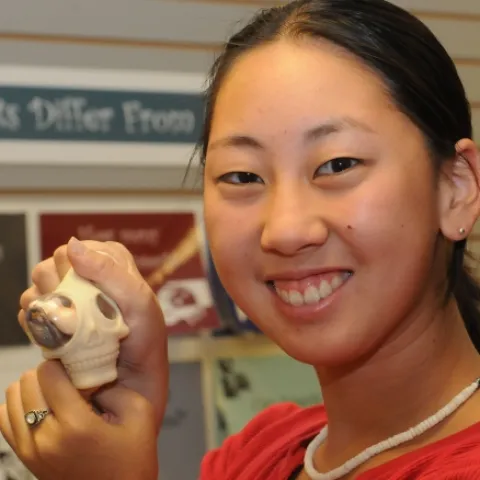
UC Davis undergraduate student William Yuen wearing his dragonfly t-shirt. He has worked part-time in the Bohart Museum of Entomology for two years. (Photo by Fran Keller)
Bug Squad: Article

Behold the Dragonfly

September 17, 2008
Some folks wear their heart on their sleeve. Others wear a dragonfly on their chest. As part of its public outreach education program and to showcase the world of insects, the Bohart Museum of Entomology at the University of California, Davis, has created t-shirts featuring a California dragonfly.
View Article
Primary Image
Like a hovering helicopter, the hover fly lingers over flowers in the Ruth Risdon Storer Garden, UC Davis Arboretum. (Photo by Kathy Keatley Garvey)
Bug Squad: Article

To Bee or Not to Bee

September 16, 2008
To bee or not to bee. Not to bee. The flying insect hovering over the Ruth Risdon Storer Garden, UC Davis Arboretum, looked like a honey bee or wasp at first glance. It wasn't. It was a hover fly or syphrid fly from the order Diptera (Greek for "two wings") and family Syrphidae.
View Article
Primary Image
A pollen-packin' honey bee heads toward a gaura (Gaura linheimeri). (Photo by Kathy Keatley Garvey)
Bug Squad: Article

High-Wire Act

September 15, 2008
It's like going to the circus. A bee circus. When you see honey bees gather pollen from a gaura (Gaura linheimeri), it's as if they ran off and joined the circus. You'll see hire-wire (er...high-stem) acts, somersaults, pirouettes, cartwheels and cliffhangers.
View Article
Primary Image
A honey bee heads for the colorful button-willows (Cephalanthus occidentalis).(Photo by Kathy Keatley Garvey)

Cute as a Button (Willow)

September 12, 2008
A bee on a ball. When it flowers, the button-willow (Cephalanthus occidentalis), also known as willow, buttonbush, honey ball, and button ball (oh, that's so close to butter ball!) attracts honey bees and butterflies like you wouldn't believe.
View Article
Primary Image
The queen bee (the largest bee, center) is surrounded by her court, the worker bees, who take care of her every need. They feed her, groom her and protect her "and then they have the additional tasks of rearing and feeding her young," said bee breeder-geneticist Susan Cobey of the UC Davis Department of Entomology. (Photo courtesy of Susan Cobey, UC Davis Department of Entomology)

The Queen Bee

September 11, 2008
If you were a queen bee, you'd be laying about 1500 to 2000 eggs today. It's your busy season. "She's an egg-laying machine," said bee breeder-geneticist Susan Cobey of the Harry H. Laidlaw Jr. Honey Bee Research Facility at UC Davis. "And she's the mother of all the bees in the hive.
View Article
Primary Image
A male gray hairstreak butterfly (Strymon melinus) nectars on sage. (Photo by Kathy Keatley Garvey)

Gray Hairstreak

September 10, 2008
"Omigosh, what's that? A gray hairstreak?" If it's in your hair, you consult a mirror, your favorite salon, or just ignore it. If you're an entomologist or a lepidopterist, a gray hairstreak is delightful.
View Article
Primary Image
This is a bee nesting block built to attract native pollinators. (Photo by Kathy Keatley Garvey)

Build It And They Will Come

September 9, 2008
Build it and they will come. Baseball's Field of Dreams? No, a bee nesting block. Think "bee condo." It's an artificial nesting site made of wood and drilled with different-sized holes and depths to accommodate the diversity of native pollinators. Often the bee block is nailed to a fence post.
View Article