
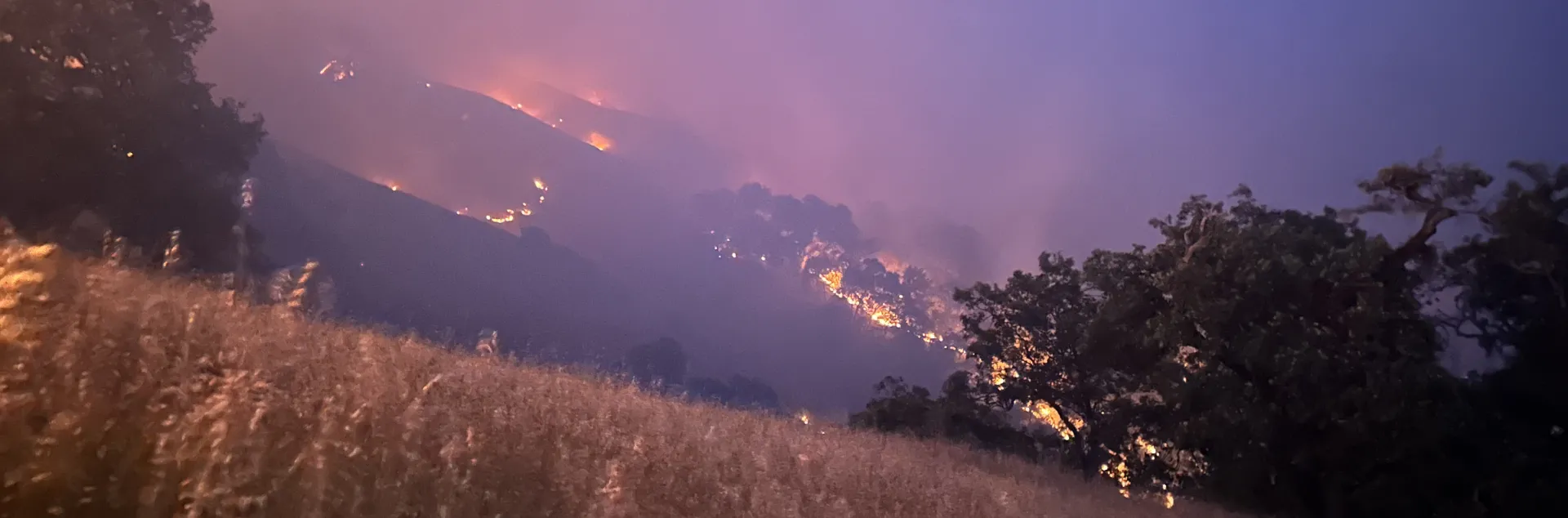
As the population of California continues to increase, the threat of wildfires also increases. This is because most wildfires are started by humans. It is also generally accepted that the threat of catastrophic fires is higher today than it has ever been. The primary reason for this is that after a 100 years of very successful fire suppression, the amount of fuels in the landscape is much higher than it was when periodic, low intensity fires regularly burned. In the past decade, some of California’s largest fires on record have occurred, including some in oak woodlands.
Image  This white paper that covers topics such as the history of fire, ecological effects of fire and how fires will affect oak woodlands in the future. By Douglas McCreary (2004) |
Image  Wildfire in an oak woodland can kill some trees outright and leave others with burn damage that may or may not eventually kill them, too. Here is a quick method for assessing the extent of burn damage and the likelihood that an affected tree will survive. By Douglas McCreary (2011) |
 California has a fire-prone Mediterranean climate, and many of its nine species of native oak trees are thought to have evolved with fire. Little has been widely published about the role of fire in the oak recruitment and mortality in the western United States, and there has been some debate about how to reintroduce fire into oak woodlands. We present here a review, synthesis, and analysis of the literature on fire and California oak species. By Katherine A. Holmes, Kari E. Veblen, Truman P. Young, and Alison M. Berry (2006) |
Fire in Oak WoodlandsThis presents the role of fire in California's oak woodlands and implications for the development of sustainable management strategies. This is part of a webinar, presented by UC Cooperative Extension in the Spring of 2012, on oak management. The concepts are based on the UC ANR booklet, "Guidelines for Managing California's Hardwood Rangelands." UC Cooperative Extension Specialist Doug McCreary presents this material. By Douglas McCreary (2012) Part of the Woodlands: Planning Oak Management Youtube series.
|
 Fire exclusion in forests across the western United States has resulted in widespread vegetation change, often with notable increases in density and cover of fire-sensitive species. In California oak woodlands, encroachment by the more shade-tolerant native Douglas-fir (Pseudotsuga menziesii) is particularly common, and results in the piercing and eventual overtopping of crowns of shade-intolerant trees. We investigated canopy competition, paired tree ages, and post-fire effects in a recently burned, encroached California black oak (Quercus kelloggii) woodland. By Matthew I. Cocking, J. Morgan Varner, and Rosemary L. Sherriff (2012) |
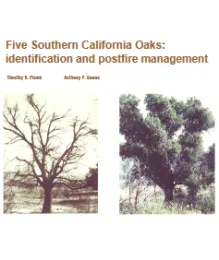 This report (GTR PSW-71) provides a guide to identifying five of the prominent species of southern California oaks coast live oak, interior live oak, California black oak, canyon live oak, and California scrub oak. It provides specific information for the identification of each of the five species; assesses fire damage for the trees on the basis of species, diameter-atbreast-height (d.b.h.), and degree of trunk charring; and, briefly outlines postfire management alternatives for firedamaged trees. By Timothy R. Plumb and Anthony P. Gomez (1983) |
 This factsheet provides information on how to manage resprouting oaks and hardwoods following fire or other types of disturbances. By Michael Jones (2024) |