

Oak Woodland Articles
In addition to the Newsletter Oaks ‘n Folks, UC’s Integrated Hardwood Range Management Program produced a wide range of publications during the 24 years it was in existence. These included Proceedings of Oak Symposia that were held every 5-6 years (links at the bottom of this page), refereed research publications resulting from scientific studies, and an assortment of targeted brochures, pamphlets and books that addressed some particular aspect oak woodland management or ecology. Here is comprehensive list of IHRMP Oak Research Publications.
The following publications can be downloaded for free.
Image 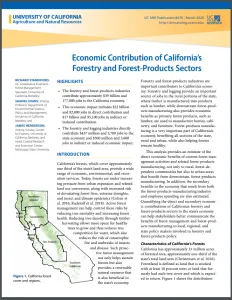 California’s forests, which cover approximately one third of the state’s land area, provide a wide range of economic, environmental, and recreation services. Today, forests are under increasing pressure from urban expansion and related land use conversion, along with increased risk of devastating forest fires, extreme droughts, and insect and disease epidemics... By Richard Standiford, Sanuel Evans, James Henderson (2020) |
Image 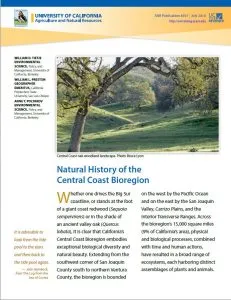 Whether one drives the Big Sur coastline, or stands at the foot of a giant coast redwood, or in the shade of an ancient valley oak, it is clear that California’s Central Coast embodies exceptional biological diversity ad natural beauty. This publication provides an overview of the geology, climate, water resources, flora and fauna, human history, ecosystem services, and natural resource management issues associated with human development of California’s Central Coast. It also provides an increased understanding of the Central Coast’s natural communities and the conservation challenges presented by exurban development, agricultural expansion, and climate change. By William D. Tietje, William L. Preston, and Anne Y. Polyakov (2019) |
A Planner’s Guide for Oak Woodlands Archived Image  Designed for professional planners, consultants, and landscape architects, this new edition provides science-based information that can guide decision-making. Chapters cover a range of planning and conservation topics including — Biology of Oak Resources The encroachment into oak woodlands addressed at the time of the first edition has not stopped, and in some cases it has continued at an alarming rate. As more development occurs in the oak woodlands this guide can provide a framework for preserving this icon of the California landscape. Edited by Gregory A. Giusti, Douglas D. McCreary, and Richard B. Standiford (2nd Ed., 2005) |
Living Among the OaksArchived Image 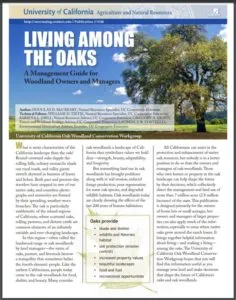 This publication contains helpful tips about how to prevent damage to oak roots, where and when to irrigate around oaks, what plants are best to plant near oaks, and what to do if a tree has been damaged by fire. By Douglas McCreary (2011) |
Image  California’s oak woodlands are our most biologically diverse broad habitat; covering 10% of the state. With 80% in private ownership the key to preserving California’s iconic oak woodlands is primarily in private hands. This guide will help landowners and managers of hardwood rangeland properties develop management plans that maintain the profitability of their properties while preserving the ecological values provided by their land. Editor Pamela Tinnin (1996) |
How to Grow California OaksArchived Image  Native oaks are a vital and important component of the vegetation of California. They grow in a wide variety of habitats and help provide a distinctive character to the landscape. Not only are they beautiful to look at, but they also provide food and shelter for many wildlife species, they stabilize soil, and they help counteract the “greenhouse effect” by taking up carbon dioxide and producing oxygen. It is estimated that one or more species of oaks grow on over 20 percent of the state’s 100 million acres of land. Unfortunately, there are also reports that some native oaks may not be regenerating very well in some locations. Poor natural regeneration raises concerns about the long term fate of these species. To assist Mother Nature in establishing new oak trees, efforts are underway to plant acorns and small seedlings. Such regeneration efforts will ensure that our magnificent oaks, which have graced California valleys and foothills for thousands of years, will be around for future generations to enjoy also. These guidelines provide successful techniques for growing oak trees. While there are many ways to get an oak tree started, the procedures described have proved successful for a variety of species and environments. By Douglas D. McCreary (1983) |
Image  This manual was written for restorationists, hardwood rangeland managers, and others involved in oak propagation and planting projects and brings together information available on regenerating rangeland oaks in California. Included are chapters on poor natural regeneration and conditions under which this problem seems most acute; acorn physiology; collection and storage of acorns for regeneration; oak seedling propagation; and planting, protecting, and maintaining oak seedlings in the field. By Douglas McCreary (2009) |
Image  This beautiful full color publication is an excellent introductory guide to a widely unnoticed universe – the minute animals called invertebrates that live in the oak woodland ecosystem in California. This fascinating world is home to a vast number of tiny creatures that provide an essential link in the health of our native California Oaks – a single acre of oak woodland may be home to 10 to 100 million individual invertebrates. Among the invertebrate animals explored in this publication are the California Oak Worm, the Filbert Weevil and the Filbert Worm, and the Tarantula Hawk. Also explored is the human impact on this delicate ecosystem. This is an excellent learning tool for anyone who cares about our California Oaks and wants to know more about this important ecosystem. By Richard Little, Ted J. Swiecki, and William Tietje (2001) |
Vineyards in an Oak LandscapeArchived Image  This publication provides background information on the biological interactions between vineyards and oak woodlands. Topics discussed include biodiversity, grape pests and diseases associated with native vegetation, and recommendations for minimizing environmental damage. By Adina M. Merenlender and Julia Crawford (1998) |
Oak Research SymposiaJune 26-28, 1979; Claremont, CA - USDA Forest Service PSW-GTR 44 November 12-14, 1986; San Luis Obispo, CA - USDA Forest Service PSW-GTR 100 October 31 – November 2, 1990; Davis, CA; USDA Forest Service PSW-GTR 126 Proceedings of the Symposium on Oak Woodlands: Ecology, Management, and Urban Interface IssuesArchived March 19-22 1996; San Luis Obispo, CA; USDA Forest Service PSW-GTR 160 October 22-25, 2001; San Diego, CA; USDA Forest Service PSW-GTR 184 October 9-12, 2006; Rohnert Park, CA; USDA Forest Service PSW-GTR 217 November 3-6, 2014; Visalia, CA; USDA Forest Service PSW-GTR 251 Proceedings of the Symposium on Oak Woodlands: Sustaining Oak Woodlands Under Current and Future Conditions October 31 – November 3, 2022; San Luis Obispo; (Proceedings Available Soon) |