A Natural Solution for California's Herds: African Catfish Peptides

California's cattle producers and agricultural communities are all too familiar with the rising challenge of antibiotic resistance, making common bacterial infections harder to treat in livestock. But imagine a future where we could tackle these infections with a natural, powerful alternative. Our research points to just that: antimicrobial peptides (AMPs) found in African catfish.

We're really excited about these peptides because African catfish thrive in pathogen-rich freshwater, naturally producing these robust immune compounds in their skin mucus as a defense. This natural origin makes them highly appealing alternatives to synthetic drugs.

Predicted Safety and Potent Action

One of the most compelling aspects of these AMPs is their predicted safety for mammals. Our initial computer analyses suggest that various catfish AMPs are generally recognized as safe (GRAS). We predict they'll be absorbed in the human intestine without causing liver, brain, or heart toxicity. Furthermore, lab tests on a promising peptide, NACAP-II, confirmed it was non-hemolytic, meaning it didn't damage rabbit red blood cells—a strong indicator of its potential safety for mammalian cells.

Beyond safety, these peptides demonstrate effectiveness against problematic bacteria. One study revealed NACAP-II's strong activity against Extended-Spectrum Beta-Lactamase (ESBL)-producing Escherichia coli—a critical concern for both animal and human health due to its resistance to many common antibiotics. Another peptide, ACAP-IV, also showed antibacterial activity against E. coli and Staphylococcus aureus. We believe these AMPs work by directly disrupting bacterial cell membranes, a mechanism that makes it harder for bacteria to develop resistance compared to how they resist traditional antibiotics.
Primary Image
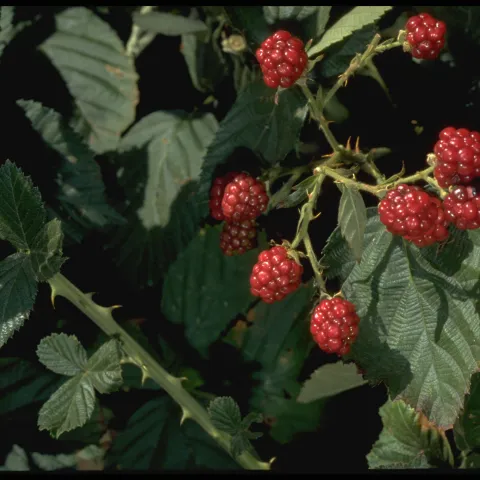
Close up of red berries on green stems with thorns
UCCE Central Sierra Agriculture: Page

Berry Production

Raspberry and Blackberry, Fruit & Nuts Research & Information Center, UC Davis Blackberry varieties do best on sunny slopes. They should be planted 4 to 5 feet apart in rows 10 feet apart and canes trained on 4 foot high, 2 wire trellis. Raspberry plantings do best on cool North slopes.
View Page
UCCE Central Sierra Agriculture: Page

Central Sierra | Agriculture | Resources

Access to agricultural resources, cost studies, pest management, and post harvest information relevant to growers, shippers, marketers, carriers, distributors, retailers, processors, and consumers of fresh horticultural crops is linked to on this page.
View Page
UCCE Central Sierra Agriculture: Page

Other Tree Crops

The foothills of the Sierra Nevada have a diversity of growing regions. Throughout the region, farmers have been successful in growing many different types of agricultural commodities.
View Page
UCCE Central Sierra Forestry: Page

Tree Mortality - Train the Trainer Workshop | Archives

Utilizing the expansive network of UCCE Master Gardener Volunteers to provide guidance to small parcel owners, local jurisdictions, NGOs, home owners associations, and interested others on revegetation/reforestation after tree mortality in the Sierra Nevada.
View Page
UCCE Central Sierra Forestry: Page

Climate Change Symposium |Archives

Agenda and Logistics Flyer Abstracts on Coping with Climate Change in the Sierran Systems, Incline Village, Nevada. The Tahoe Basin and Climate Change: Coping with Climate Change in Sierran Systems: Incorporating Climate into Land and Resource Management and Developing Adaptation Strategies.
View Page
UCCE Central Sierra Forestry: Page

Vegetation Management Workshop | Archives

Independent Review Panel Report_Veg Mgmt Wkshp_4-30-08 Supplemental Appendices to Independent Review Panel Rpt _4-30-08 Sensitive Areas workshop Flyer February 20-22, 2008 Vegetation Management Workshop Agenda Speaker and Panelist Contact Information Smith and Kocher - Case Study Issue Identificatio...
View Page
UCCE Central Sierra Forestry: Page

Reforestation Workshops | Archives

The University of California has collaborated with the California Society of American Foresters, Cal Fire and the Natural Resources Conservation Service to reach out to landowners affected by tree mortality through workshops and educational materials.
View Page
UCCE Central Sierra Forestry: Page

Resources

California Tahoe Conservancy - Develops and implement programs through acquisitions and site improvements to improve water quality in Lake Tahoe, preserve the scenic beauty and recreational opportunities of the region, provide public access, preserve wildlife habitat areas, and manage and restore la...
View Page
UCCE Central Sierra Forestry: Page

Tree Mortality | Archives

Tree mortality resulting from the drought of 2012 to 2016 was unprecedented. Here is a recent summary from the Tree Mortality Data Network in California Agriculture gives an overview of the size and effects of the mass tree mortality event.
View Page
UCCE Central Sierra Forestry: Page

Tree Mortality: Master Gardener Tool Kit

The following presentations were given at the training. MGs are welcome to use and modify any of the presentations material below. In addition to the full presentations, we have developed a template presentation that incorporates all of the material into a single presentation.
View Page