A Natural Solution for California's Herds: African Catfish Peptides

California's cattle producers and agricultural communities are all too familiar with the rising challenge of antibiotic resistance, making common bacterial infections harder to treat in livestock. But imagine a future where we could tackle these infections with a natural, powerful alternative. Our research points to just that: antimicrobial peptides (AMPs) found in African catfish.

We're really excited about these peptides because African catfish thrive in pathogen-rich freshwater, naturally producing these robust immune compounds in their skin mucus as a defense. This natural origin makes them highly appealing alternatives to synthetic drugs.

Predicted Safety and Potent Action

One of the most compelling aspects of these AMPs is their predicted safety for mammals. Our initial computer analyses suggest that various catfish AMPs are generally recognized as safe (GRAS). We predict they'll be absorbed in the human intestine without causing liver, brain, or heart toxicity. Furthermore, lab tests on a promising peptide, NACAP-II, confirmed it was non-hemolytic, meaning it didn't damage rabbit red blood cells—a strong indicator of its potential safety for mammalian cells.

Beyond safety, these peptides demonstrate effectiveness against problematic bacteria. One study revealed NACAP-II's strong activity against Extended-Spectrum Beta-Lactamase (ESBL)-producing Escherichia coli—a critical concern for both animal and human health due to its resistance to many common antibiotics. Another peptide, ACAP-IV, also showed antibacterial activity against E. coli and Staphylococcus aureus. We believe these AMPs work by directly disrupting bacterial cell membranes, a mechanism that makes it harder for bacteria to develop resistance compared to how they resist traditional antibiotics.
Page

Another page for Erin

This is a complete header 2This is a complete paragraph This is a complete paragraph This is a complete paragraph This is a complete paragraph This is a complete paragraph This is a complete paragraph This is a complete paragraph This is a complete paragraph This is a complete paragraphBenefitsFlexible…
View Page
Page

Another cards

 Card titleSome quick example text to build on the card title and make up the bulk of the card's content.Item oneItem twoItem threeGo somewhere Card titleSome quick example text to build on the card title and make up the bulk of the card's content.Item oneItem twoItem threeGo somewhere Card…
View Page
Primary Image
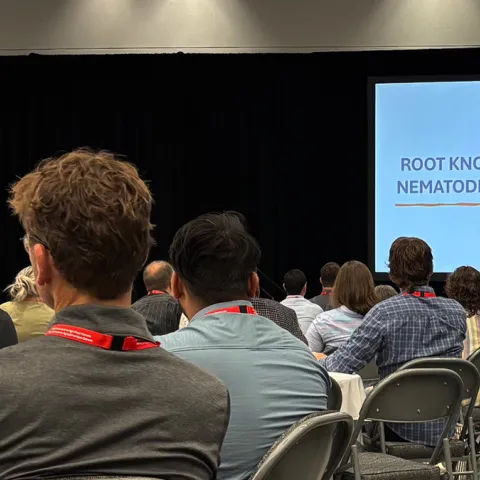
A plenary session at the Society of Nematologists' meeting in Victoria, B.C. (SON Photo)
Bug Squad: Article

Congrats to Our UC Davis Nematologists!

August 20, 2025
By Kathy Keatley Garvey
 Congratulations to our UC Davis nematologists who drew admiration and applause at the 64th annual meeting of the Society of Nematologists (SON), held in Victoria, British Columbia.Doctoral candidate Alison Blundell of the laboratory of associate professor Shahid Siddique, UC Davis…
View Article
Primary Image
Garden dahlia flowers
HOrT COCO-UC Master Gardener Program of Contra Costa: Article

Late-Summer Dahlia Problems - What's up?

August 20, 2025
By Dawn A Kooyumjian
A favorite summer flower is dahlias – little ones, big ones and even really big ones as is Dahlia imperialis growing from 8 to 12 feet tall.Were your dahlias looking fantastic earlier this summer, full of stunning blooms and healthy leaves but now they are starting to look a little tired? Here is a short…
View Article
Primary Image
Sonoma County Rangeland
On the Range: Article

Conservation benefits of grazing in Marin County

August 20, 2025
By Devii R Rao
Livestock grazing can help maintain grasslands, improve native species habitat, control weeds, and reduce wildfire fuelsClick here for the pdf fact sheet version of this article. Biodiversity hotspots at risk California grasslands are often dominated by non-native European annual grasses. At the…
View Article
Primary Image
Field Day Tour Stop
UC Dry Bean Blog: Article

2025 Kearney Alfalfa, Forage and Field Crops Field Day - September 18, 2025

August 20, 2025
By Nicholas E Clark, Michelle M Leinfelder-Miles, Jackie Atim
The annual Kearney Alfalfa, Forage and Field Crops Field Day is scheduled for Thursday, September 18, 2025.The field day is taking place in its traditional location of the UC Kearney Agriculture Research and Experiment Center at 9240 S. Riverbend Ave., Parlier, CA 93648.This half-day meeting is free to…
View Article