A Natural Solution for California's Herds: African Catfish Peptides

California's cattle producers and agricultural communities are all too familiar with the rising challenge of antibiotic resistance, making common bacterial infections harder to treat in livestock. But imagine a future where we could tackle these infections with a natural, powerful alternative. Our research points to just that: antimicrobial peptides (AMPs) found in African catfish.

We're really excited about these peptides because African catfish thrive in pathogen-rich freshwater, naturally producing these robust immune compounds in their skin mucus as a defense. This natural origin makes them highly appealing alternatives to synthetic drugs.

Predicted Safety and Potent Action

One of the most compelling aspects of these AMPs is their predicted safety for mammals. Our initial computer analyses suggest that various catfish AMPs are generally recognized as safe (GRAS). We predict they'll be absorbed in the human intestine without causing liver, brain, or heart toxicity. Furthermore, lab tests on a promising peptide, NACAP-II, confirmed it was non-hemolytic, meaning it didn't damage rabbit red blood cells—a strong indicator of its potential safety for mammalian cells.

Beyond safety, these peptides demonstrate effectiveness against problematic bacteria. One study revealed NACAP-II's strong activity against Extended-Spectrum Beta-Lactamase (ESBL)-producing Escherichia coli—a critical concern for both animal and human health due to its resistance to many common antibiotics. Another peptide, ACAP-IV, also showed antibacterial activity against E. coli and Staphylococcus aureus. We believe these AMPs work by directly disrupting bacterial cell membranes, a mechanism that makes it harder for bacteria to develop resistance compared to how they resist traditional antibiotics.
IGIS: Article

Job Opening: Executive Director at the GIF

June 30, 2014
By Maggi Kelly
The Geospatial Innovation Facility at the University of California, Berkeley is recruiting for an Executive Director (Academic Coordinator). The mission of The Geospatial Innovation Facility (GIF) http://gif.berkeley.
View Article
UC Weed Science (weed control, management, ecology, and minutia): Article

Medusahead Management Guide in the works

June 30, 2014
By Guy Kyser
Joe DiTomaso and I, with several other coauthors, have almost finished the Medusahead Management Guide for the Western States. This project is supported by a grant from Western IPM.
View Article
Primary Image
A leaffooted bug on a tomato. This is Leptoglossus phyllopus, as identified by senior museum scientist Steve Heydon of the Bohart Museum of Entomology, UC Davis. (Photo by Kathy Keatley Garvey)

Can You See the Leaf?

June 27, 2014
By Kathy Keatley Garvey
Once you've seen a leaffooted bug (genus Leptoglossus), you'll never forget it. If you look closely, you'll see a leaflike structure on each hind leg. It's especially noticeable when the bug is on a brightly colored tomato or pomegranate.
View Article
Primary Image
Damselfly on a leaf in the late afternoon. (Photo by Kathy Keatley Garvey)

Like a Needle in a Haystack

June 26, 2014
By Kathy Keatley Garvey
Finding a tan-colored damselfly in a patch of fading English lavender is like finding a needle in the proverbial haystack. They're so tiny and inconspicuous that they're easy to miss. They're about an inch long and so slender that they look like flying needles.
View Article
Colusa County: Article

Sacramento Valley Almond News - July 2014

June 26, 2014
New IPM Advisor New Farm Advisor Advisor Retirement Leaf analysis and salinity monitoring Research reveals the core components of optimum almond production Navel orangeworm management Nitrogen Management in Orchard Crops Meeting MEETING ANNOUNCEMENT: Nitrogen Management in Orchard Crops - Thursday,...
View Article
Primary Image
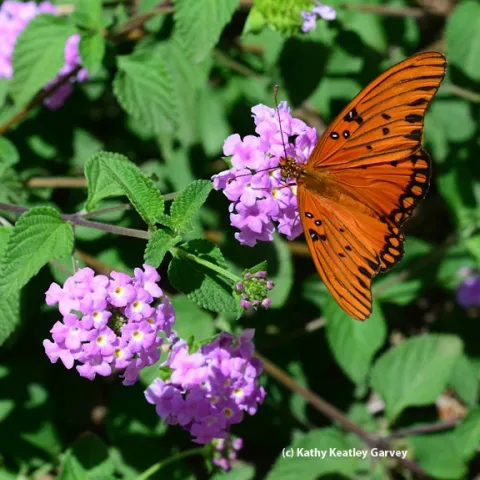
A Gulf Fritillary sips nectar from a Mexican sunflower (Tithonia), unaware of what will soon occur. (Photo by Kathy Keatley Garvey)

Faster Than a Speeding Bullet

June 25, 2014
By Kathy Keatley Garvey
Butterflies flutter. Bees don't. Indeed, some bees seem to possess Superman's extraordinary power of "faster than a speeding bullet." They're just lacking a blue costume, a red cape and an "S" on their thorax.
View Article
Colusa County: Article

Open House

June 25, 2014
Please join the UC Master Gardeners of Colusa County for our Open House Thursday June 26 4-6pm 100 Sunrise Blvd, Colusa Conference room...
View Article
UC Weed Science (weed control, management, ecology, and minutia): Article

The role of hand weeding in weed management

June 25, 2014
By Steven A Fennimore
Hand weeding is undoubtedly the oldest method of weed control, as old as agriculture itself. The weed uprooted by hand pulling or with a hoe dies from desiccation.
View Article
Primary Image
A praying mantis climbs down a lavender stem to get a closer look at the sleeping boy bees, longhorned digger bees, Melissodes agilis. (Photo by Kathy Keatley Garvey)

Sleeping with the Enemy

June 24, 2014
By Kathy Keatley Garvey
Just call it sleeping with the enemy. But how can you sleep when you sense a predator in your midst? Last night, as usual, was Boys' Night Out in our lavender patch.
View Article