A Natural Solution for California's Herds: African Catfish Peptides

California's cattle producers and agricultural communities are all too familiar with the rising challenge of antibiotic resistance, making common bacterial infections harder to treat in livestock. But imagine a future where we could tackle these infections with a natural, powerful alternative. Our research points to just that: antimicrobial peptides (AMPs) found in African catfish.

We're really excited about these peptides because African catfish thrive in pathogen-rich freshwater, naturally producing these robust immune compounds in their skin mucus as a defense. This natural origin makes them highly appealing alternatives to synthetic drugs.

Predicted Safety and Potent Action

One of the most compelling aspects of these AMPs is their predicted safety for mammals. Our initial computer analyses suggest that various catfish AMPs are generally recognized as safe (GRAS). We predict they'll be absorbed in the human intestine without causing liver, brain, or heart toxicity. Furthermore, lab tests on a promising peptide, NACAP-II, confirmed it was non-hemolytic, meaning it didn't damage rabbit red blood cells—a strong indicator of its potential safety for mammalian cells.

Beyond safety, these peptides demonstrate effectiveness against problematic bacteria. One study revealed NACAP-II's strong activity against Extended-Spectrum Beta-Lactamase (ESBL)-producing Escherichia coli—a critical concern for both animal and human health due to its resistance to many common antibiotics. Another peptide, ACAP-IV, also showed antibacterial activity against E. coli and Staphylococcus aureus. We believe these AMPs work by directly disrupting bacterial cell membranes, a mechanism that makes it harder for bacteria to develop resistance compared to how they resist traditional antibiotics.
Primary Image
BRICKS mark the spot where yellowjackets are nesting at the Harry H. Laidlaw Jr. Honey Bee Research Facility. (Photo by Kathy Keatley Garvey)
Bug Squad: Article

Hanging Out to Get In

November 29, 2010
They're here. They're there. The Western yellowjacket (Vespula pensylvanica) likes to hang around bee hives. If you're a beekeeper, you've probably seen them nesting in a rodent burrow or hollow log near your hives. At the Harry H. Laidlaw Jr.
View Article
UC Weed Science (weed control, management, ecology, and minutia): Article

Catchweed bedstraw - a sticky problem in landscapes

November 28, 2010
By Brad Hanson
Early winter is is a good time of year to talk about another landscape weed problem - catchweed bedstraw (Galium aperine) also known as cleavers in much of the rest of the world (among many other names).
View Article
Primary Image
YELLOWJACKETS taking bait. (Photo by Erin Wilson)
Bug Squad: Article

Yellowjackets!

November 26, 2010
Yellowjackets is a word you never want to end with a period, but with an exclamation point! They probably annoy you when they invite themselves to your barbecue to partake of your hamburger and other protein-rich foods. They're persistent predators.
View Article
Primary Image
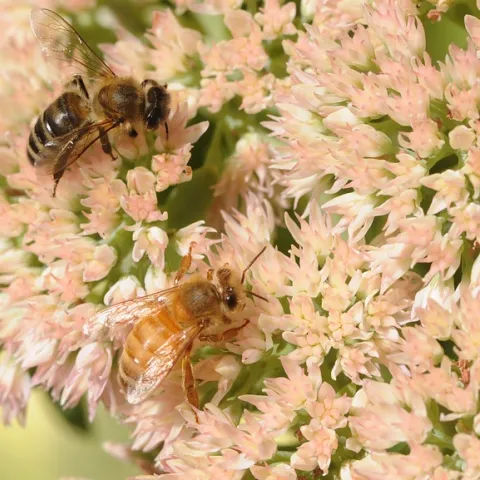
HONEY BEE foraging on pomegranate blossom. Without bees, there would be no pomegranates. (Photo by Kathy Keatley Garvey)
Bug Squad: Article

Bee-ing Thankful

November 25, 2010
President Obama just pardoned a couple of turkeys--Apple and Cider. They won't make it to the White House Thanksgiving dinner today. But what he could have done--when he was pardoning the turkeys--was to praise the honey bees.
View Article
Primary Image
SPOTLIGHTING bees, the North American Bee Calendar features 12 species of bees. Some are pictured here. Most of the photos are by noted insect photographer Rollin Coville. (The honey bee is the work of Kathy Keatley Garvey)
Bug Squad: Article

Mark Your Calendar

November 24, 2010
Mark your calendar. If you're a bee aficionada and haven't ordered your educational North American Bee Calendar, you have until Tuesday, Nov. 30 to place your order. It's for a good cause.
View Article
UC Weed Science (weed control, management, ecology, and minutia): Article

Department article on UC Davis Weed Science Program

November 23, 2010
By Brad Hanson
Although somewhat self serving (isn't that part of what a blog is?), I thought I'd post a link to an article about the the Weed Science group at UC Davis.
View Article
Primary Image
ROSE GARDEN--The All-America Rose Selections (AARS) Test Garden on Hopkins Road, UC Davis, features 30 new rose varieties--and insects have their pick. (Photo by Kathy Keatley Garvey)
Bug Squad: Article

Insects Find This Garden Rosy

November 23, 2010
It's the kind of rose garden that Joe South would write about. The Grammy-award winning songwriter-guitarist who wrote "I Never Promised You a Rose Garden" (popularized by country singer Lynn Anderson), has probably never seen this rose garden, though.
View Article
UC Weed Science (weed control, management, ecology, and minutia): Article

Current Issues in Vineyard Health (Symposium at UC Davis)

November 23, 2010
By Brad Hanson
Date: November 30, 2010 Time: 9:00 AM - 4:00 PM Contact: Student Services staff is available M-F, 8 a.m.-5 p.m. Phone: (800)752-0881 From Davis or Woodland (530)757-8777 Sponsor: UC Davis Extension Location: Da Vinci Building Address: 1632 Da Vinci Ct. Davis, CA Web site: http://extension.ucdavis.
View Article
Primary Image
HONEY BEE foraging at the San Ysidro Ranch in Montecito. (Photo by Kathy Keatley Garvey)
Bug Squad: Article

So Much Has Happened...

November 22, 2010
It's a romantic getaway. Say "San Ysidro Ranch" and someone will tell you that John F. Kennedy and his bride, Jackie, honeymooned there in September 1953. So much has happened since then. JFK went on to win the presidency in 1961 and tragically, 47 years ago today--Nov.
View Article
Colusa County: Article

December 2010

November 22, 2010
I apologize for re-posting this newsletter, I added many new 4H members and wanted them to receive the current newsletter.
View Article