
California's cattle producers and agricultural communities are all too familiar with the rising challenge of antibiotic resistance, making common bacterial infections harder to treat in livestock. But imagine a future where we could tackle these infections with a natural, powerful alternative. Our research points to just that: antimicrobial peptides (AMPs) found in African catfish.
We're really excited about these peptides because African catfish thrive in pathogen-rich freshwater, naturally producing these robust immune compounds in their skin mucus as a defense. This natural origin makes them highly appealing alternatives to synthetic drugs.
Predicted Safety and Potent Action
One of the most compelling aspects of these AMPs is their predicted safety for mammals. Our initial computer analyses suggest that various catfish AMPs are generally recognized as safe (GRAS). We predict they'll be absorbed in the human intestine without causing liver, brain, or heart toxicity. Furthermore, lab tests on a promising peptide, NACAP-II, confirmed it was non-hemolytic, meaning it didn't damage rabbit red blood cells—a strong indicator of its potential safety for mammalian cells.
Beyond safety, these peptides demonstrate effectiveness against problematic bacteria. One study revealed NACAP-II's strong activity against Extended-Spectrum Beta-Lactamase (ESBL)-producing Escherichia coli—a critical concern for both animal and human health due to its resistance to many common antibiotics. Another peptide, ACAP-IV, also showed antibacterial activity against E. coli and Staphylococcus aureus. We believe these AMPs work by directly disrupting bacterial cell membranes, a mechanism that makes it harder for bacteria to develop resistance compared to how they resist traditional antibiotics.

The caterpillars in my garden


As Eric Carle once wrote, there was a “very hungry caterpillar.” It hatched from an egg and began its search for food. After about two weeks, it became a big, fat caterpillar—two thousand times its original size! Then, it built a small cocoon, stayed inside for another two weeks, and eventually emerged as a beautiful butterfly. Finding caterpillars in your garden is a wonderful way to observe the butterfly lifecycle up close and appreciate this critical stage of metamorphosis—the transformation between egg and chrysalis.
Caterpillars are often mistaken for pests in the garden. While some, like the tomato hornworm, can cause damage, their overall impact on plants is usually minimal, especially in a healthy, balanced ecosystem that has evolved to tolerate them. In fact, caterpillars play a crucial role as an essential food source for birds and a vital part of the food web. This is especially true during the breeding season when adult birds need to meet the demands of hungry chicks.
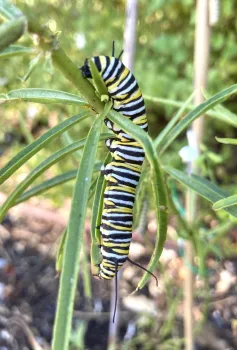
Caterpillars are picky eaters, so it is important to identify the host plants for specific species. My favorite caterpillars are Monarchs. Their host plant, milkweed, is the only plant where they lay their eggs and the only food their caterpillars will eat.
While eating milkweed, Monarch caterpillars grow 3,000 times their original weight. They go through several instars (growth stages), shedding their skin multiple times. Some caterpillars hide on the undersides of leaves, and others use camouflage to avoid predators. Monarchs and Pipevine Swallowtails absorb toxic compounds called cardenolides from their host plants and store these poisons in their bodies. This makes them distasteful to birds and other predators.
The U.S. Fish and Wildlife Service (USFWS) has determined that Monarchs are threatened under the Endangered Species Act. That means they are likely to become endangered soon. In California, they are protected by the California Department of Fish and Wildlife, which prohibits raising or handling without a scientific permit. Participate in Community Science by reporting caterpillars to the Monarch Larva Monitoring Project or https://www.inaturalist.org/.
Use sustainable gardening practices and strategies to support caterpillars and the butterflies and moths they become. Plant California native plants that have evolved alongside local wildlife and provide essential resources caterpillars need. The more native plants in your garden, the more caterpillars you’ll attract.
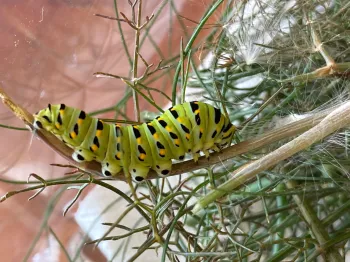
Provide both native host plants and nectar plants. Different species of butterflies and moths have specific host plant preferences. Here are some common examples:
- Milkweed for Monarchs (Asclepias fascicularis)
- Oak trees for a wide variety of caterpillar species, including the California Sister.
- Herbs, dill, parsley, and fennel for swallowtails
- California pipevine (Aristolochia californica) for the Pipevine Swallowtail
Avoid using chemical pesticides and herbicides, especially neonicotinoids, which can harm not only caterpillars but all insects in your garden. Instead, natural pest control methods, such as Integrated Pest Management (IPM), should be used.
Predators like yellow jackets and paper wasps are carnivorous and prey on caterpillars. To discourage yellow jackets:
- Remove pet food from outside.
- Use traps, and when you find a nest, contact the Mosquito and Vector Control District of Marin and Sonoma County for safe nest removal (a free service).
A significant parasite affecting Monarchs is Ophryocystis elektroscirrha (OE). Infection occurs when a caterpillar ingests OE spores from an infected butterfly on a milkweed leaf. The spores lodge in the caterpillar’s gut, causing weakness, deformities, and death. Non-migrating Monarchs that rely on non-native tropical milkweed (Asclepias curassavica) are particularly vulnerable to OE. Unlike native milkweed species, tropical milkweed does not die back seasonally, allowing OE spores to accumulate over time. Please cut back the foliage on the ground or replace it with the native species.
By creating a garden that supports caterpillars, you are nurturing the next generation of butterflies and moths and contributing to a healthier, balanced ecosystem for all wildlife.
By Alice Cason, April 19, 2025