

The eave overhang protects your home from the elements, however, depending on their design, they can also allow embers to enter through under-eave attic vents. With open-eave construction, gaps between the rafter tails and the blocking can be vulnerable to ember entry. Generally, soffits (boxed-in eaves) are more robust to ember exposure.
In terms of fire exposure (embers or flames), a narrow overhang is arguably better. However, in this case the gutters could expose the attic directly to flame contact if ignited. Also, you should consider other exposures your home will face. For example, a fence attached to the house or vegetation close to exterior walls would directly expose the eave and edge of the roof to flame contact, regardless of eave design.
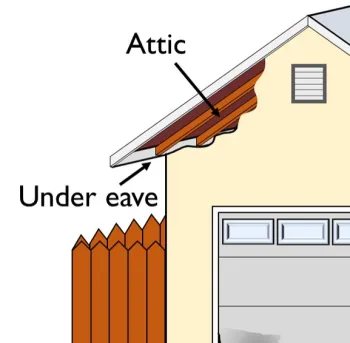
Diagram of an eave on a home.
How Can You Protect Your Eaves?
Because of the variety of eaves and configurations, these guidelines are generic, but should give you an idea on how to improve the fire resistance of your eaves:
- Keep under-eave areas free of debris: particularly for open eaves, keep the under-eave area clean of debris, insects, and other combustible materials.
- Remove combustible materials and vegetation directly under or adjacent to the eave: if ignited, these materials can lead to direct flame contact to your eaves.
- Retrofit or replace your under-eave vents: either upgrade vents to fire-resistant options or retrofit your existing vents with metal mesh (1/8-inch or 1/16-inch screening). For more information about protecting your vents, please visit our Vents webpage.
- Inspect eaves for gaps: particularly with open-eave construction, inspect for holes and gaps around rafter roof tails and blocking.
- All gaps should be plugged or caulked.
- If possible, enclose open eaves.
Below are some examples of vulnerabilities and suggested actions to protect your eaves:
Eave Type | Description and Vulnerabilities | Recommendations |
Closed Eave Image 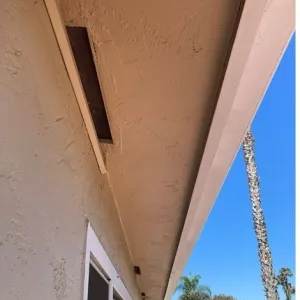 |
|
|
Coated Under-Eave Image  |
|
|
Open Eave Image 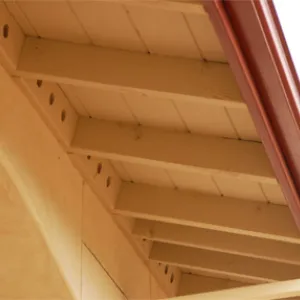 |
|
|
Open Eave, Joist Bay Image 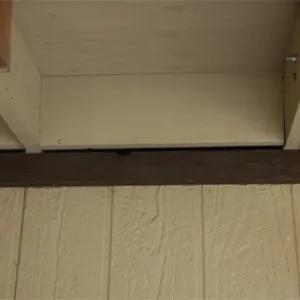 |
|
|
California Regulations
According to Chapter 7A of the California Building Code, eaves must meet either of the following requirements:
- Meet the requirement of the standard test SFM 12-7A-3.
- Protected by ignition-resistant material or non-combustible on the exposed underside.
Due to the differences between closed and open eave designs, the details of complying will vary depending on the construction technique.
- Closed eaves: If the soffit material is rated as non-combustible (for example, three-coat stucco, or a fiber cement soffit material) or ignition resistant (for example, exterior rated fire-retardant-treated plywood), then the design would comply with the provisions of Chapter 7A.
- If you want to use untreated plywood, or wood tongue-and-groove material as the soffit material, then this construction would have to be tested to SFM 12-7A-3.
- The material and design being proposed for use must be approved and certified by an accredited fire testing laboratory if they haven't been tested.
- Open eave: A generic assembly could consist of 2x rafter tails, ACX plywood sheathing, and 2x4 or 2x6 blocking between the rafter tails. This assembly will have to be tested to SFM 12-7A-3 and pass.
- Since this assembly has been rated as fire resistant in the building code, there have been discussions as to whether this assembly should be tested to SFM Standard 12-7A-3. The California Building Standards Commission is currently considering language that would clarify this issue.
- If exterior rated fire retardant products were used in the assembly (plywood sheathing, 2x rafter tails and blocking), the assembly would comply because ignition-resistant materials were used.
- If non-combustible materials (fiber cement panel, stucco) were used as the sheathing it could also comply.
Products and assemblies that have complied with Chapter 7A can be found in the WUI Product Handbook.
Additional Resources
Check out these eave-related wildfire preparedness resources from Fire Network Members and our colleagues!
These materials are not maintained by UC ANR and may not meet current accessibility standards. If you need assistance accessing this content or require an accessible format, please contact the journal or individual listed after the link provided below.
- Fire and Materials Conference proceedings article, "Vulnerability of the Eave to Direct Flame Contact and Radiant Exposures" (Quarles et al. 2011). (Stephen L. Quarles)
Fire Safety Journal article, "Exposing Siding Treatments, Walls Fitted with Eaves, and Glazing Assembles to Fire Brand Showers" (Manzello et al. 2012). (Fire Safety Journal)