

The roof's large surface area can make it extremely vulnerable to embers during a fire. Specifically, debris can accumulate close to roof-wall intersections, edges, skylights, and vents, and ignite during a fire. Complex roofs, where the roof meets vertical walls (e.g., a roof with dormers, or a split-level house) present additional vulnerabilities that must be addressed. Roofs generally ignite at edges and intersections, so these areas should be prioritized.
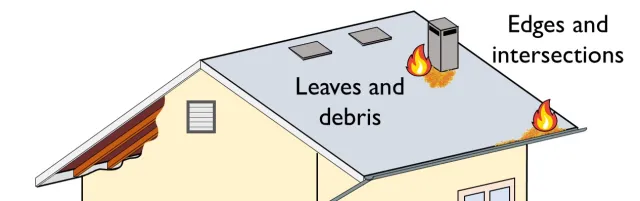
Diagram illustrating the areas on a roof most vulnerable to wildfire.
How Can You Protect Your Roof?
Due to the wide variety of roof designs, here are some guidelines for retrofitting or maintenance based on different roof components.
Roof Component | Vulnerabilities | Recommendations |
Dormers 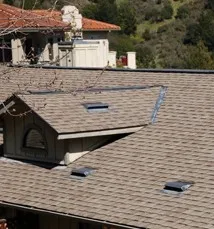 |
|
|
Edges and Intersections 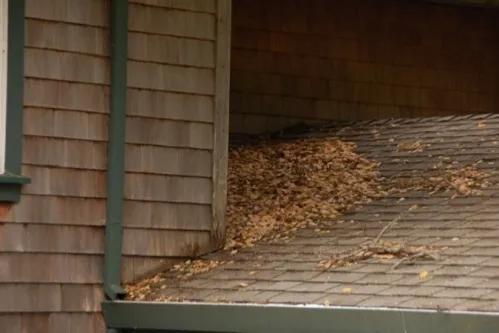 |
|
|
Roof Vents 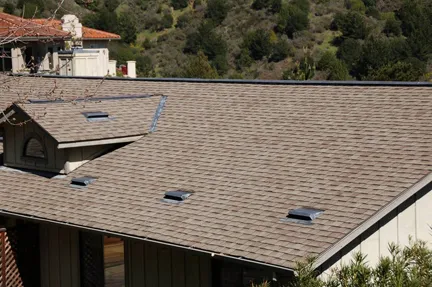 |
|
|
Skylights 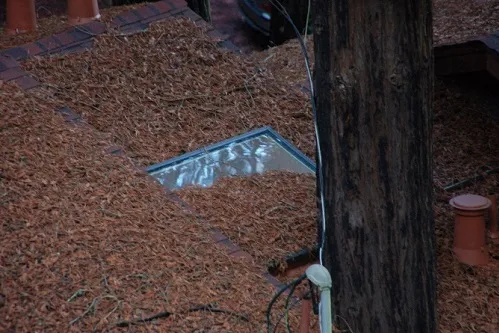 |
|
|
Solar Panels 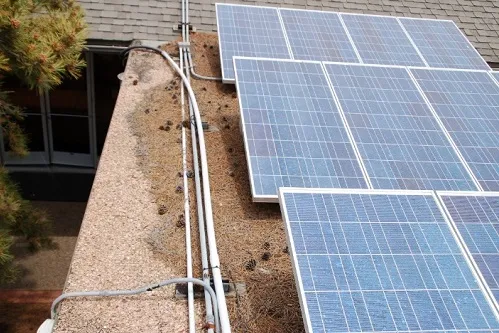 |
|
|
Valleys 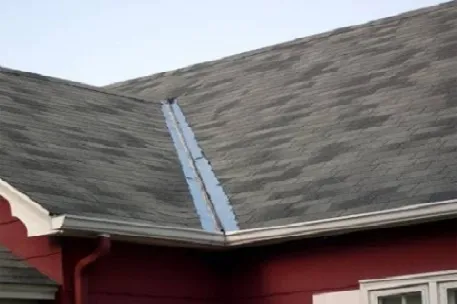 |
|
|
California Regulations
The roof covering should be built to prevent the intrusion of flames and embers. According to Chapter 7A of the California Building Code:
- Roofs shall have a roofing assembly installed in accordance with its listing and the manufacturer’s installation instructions.
- Where the roof profile allows a space between the roof covering and roof decking, the spaces shall be constructed to prevent the intrusion of flames and embers, be firestopped with approved materials or have one layer of minimum 72 pound (32.4 kg) mineral-surfaced nonperforated cap sheet complying with ASTM D 3909 installed over the combustible decking.
- Where valley flashing is installed, the flashing shall be not less than 0.019-inch (0.48 mm) No. 26 gage galvanized sheet corrosion-resistant metal installed over not less than one layer of minimum 72 pound (32.4 kg) mineral-surfaced nonperforated cap sheet complying with ASTM D 3909, at least 36-inch-wide (914 mm) running the full length of the valley.
Local additions to the code may exist in your community. Your local authorities can provide you with more information. Products and assemblies that have complied with Chapter 7A can be found in the WUI Product Handbook.
What Does Fire Rating Mean?
Fire ratings for roof coverings are based on standard tests that evaluate three fire-related characteristics:
- Resist the spread of fire into the attic
- Resist flame spreading on the roof covering,
- Production of burning embers.
Class A roofs provide the greatest protection, while Class C roofs provide the least. Non-fire retardant treated wood shakes are not rated (i.e., their rating doesn’t meet the requirements for Class C) and should not be used in wildfire prone areas. Class A materials include flat or barrel-shaped roof tiles, fiberglass asphalt composition shingles, and metal roofs (i.e., steel or copper). Fire-retardant pressure-treated shakes and shingles are the most common Class B roofing material. Class C fire rated roof coverings include recycled plastic and rubber products and roof aluminum coverings. Class B and C roof coverings can typically meet Class A requirements when additional underlayment materials are used.
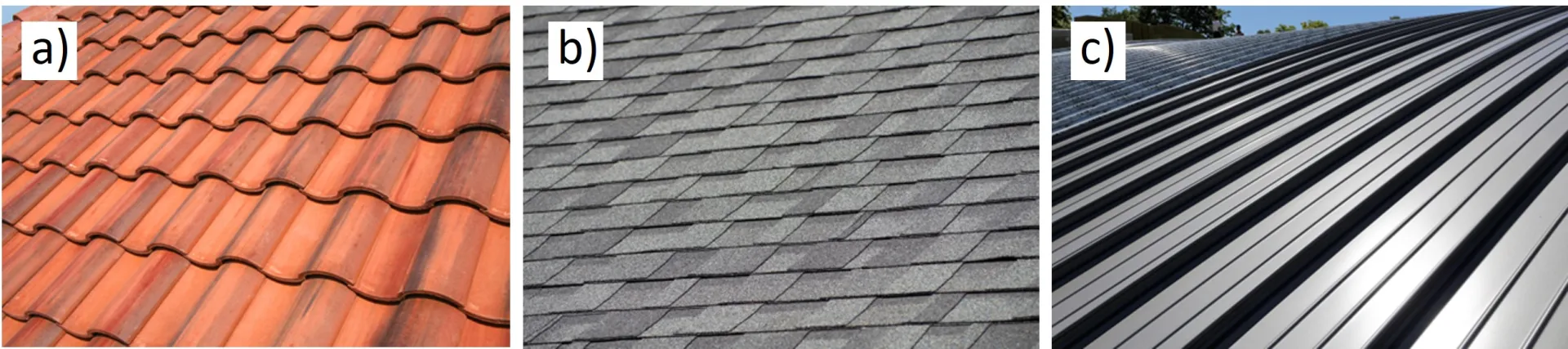
Examples of Class A roof coverings: a) ceramic tiles; b) asphalt shingles; c) metal (steel) panels.
Details Matter: Stand-Alone or Assembly-Rated?
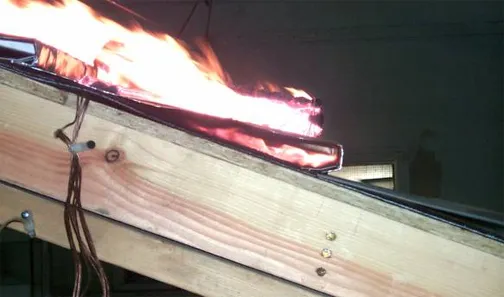
Some roof coverings rely on an underlying material, or special installation techniques, to improve their fire rating. Fire ratings for roof coverings that require an additional material are typically referred to as a "by-assembly," as opposed to a "stand-alone," fire rating. Examples of a “by assembly” fire rating include fire-retardant treated wood shakes, aluminum and recycled plastic and rubber roof coverings. Common underlying materials include a mineral surfaced cap sheet (formerly referred to as a Type 72 cap sheet) adequate to provide Class A membrane construction, and a panelized fiberglass gypsum board.
The testing methodology is provided in the American Society for Testing and Materials (ASTM) Standard E-108, Underwriters Laboratory (UL) Standard 790, and National Fire Protection Association (NFPA) Standard 276. These standard test methods are similar, so there is no need to worry about which test was used to evaluate your roof covering.