A Natural Solution for California's Herds: African Catfish Peptides

California's cattle producers and agricultural communities are all too familiar with the rising challenge of antibiotic resistance, making common bacterial infections harder to treat in livestock. But imagine a future where we could tackle these infections with a natural, powerful alternative. Our research points to just that: antimicrobial peptides (AMPs) found in African catfish.

We're really excited about these peptides because African catfish thrive in pathogen-rich freshwater, naturally producing these robust immune compounds in their skin mucus as a defense. This natural origin makes them highly appealing alternatives to synthetic drugs.

Predicted Safety and Potent Action

One of the most compelling aspects of these AMPs is their predicted safety for mammals. Our initial computer analyses suggest that various catfish AMPs are generally recognized as safe (GRAS). We predict they'll be absorbed in the human intestine without causing liver, brain, or heart toxicity. Furthermore, lab tests on a promising peptide, NACAP-II, confirmed it was non-hemolytic, meaning it didn't damage rabbit red blood cells—a strong indicator of its potential safety for mammalian cells.

Beyond safety, these peptides demonstrate effectiveness against problematic bacteria. One study revealed NACAP-II's strong activity against Extended-Spectrum Beta-Lactamase (ESBL)-producing Escherichia coli—a critical concern for both animal and human health due to its resistance to many common antibiotics. Another peptide, ACAP-IV, also showed antibacterial activity against E. coli and Staphylococcus aureus. We believe these AMPs work by directly disrupting bacterial cell membranes, a mechanism that makes it harder for bacteria to develop resistance compared to how they resist traditional antibiotics.
Primary Image
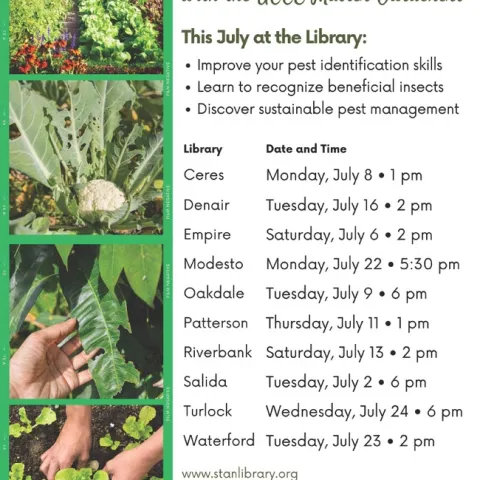
7/2 Tues 6:00 pm Salida
7/6 Sat	2:00 pm	Empire
7/8 Mon	1:00 pm	Ceres
7/9 Tues 6:00 pm Oakdale
7/11 Thur 1:00 pm Patterson
7/13 Sat 2:00 pm Riverbank
7/16 Tues 2:00 pm Denair
7/22 Mon 5:30 pm Modesto
7/23 Tues 2:00 pm Waterford
7/24 Wed 6:00 pm Turlock
The Stanislaus Sprout: Article

JULY LIBRARY TALKS – Pest Management in the Garden

June 27, 2024
By Anne E Schellman
Every gardener has stories about battling pests in their gardens such as aphids, mites, ants, scales, and whiteflies, along with diseases such as powdery mildew, damping off, and various fungal infections! We cannot experience the joys of gardening without also dealing with the pests and diseases th...
View Article
Primary Image
Carpenteria californica is a beautiful flowering evergreen shrub native to the Sierra Nevada foothills. It does well planted in a shady area on the Valley floor. (Photo: Wikimedia Commons)
Fresno Gardening Green: Article

This week in the garden: June 28 - July 4

June 27, 2024
Native plants have the ability to survive in the worst of times and thrive during the good times. They require less care, less water and can make spectacular flower displays. Tasks Use Bacillus thuringiensis (Bt) to control petunia bud worms and tomato horn worms.
View Article
UCCE Siskiyou: Article

New Agronomy Advisor Jagdeep Singh

June 27, 2024
Jagdeep comes from Punjab, India, a region grappling with severe water scarcity and complex farmer-government relations. Growing up in the agricultural heartland of India, he witnessed firsthand the challenges faced by farmers due to depleting groundwater levels and changing climate patterns.
View Article
Primary Image
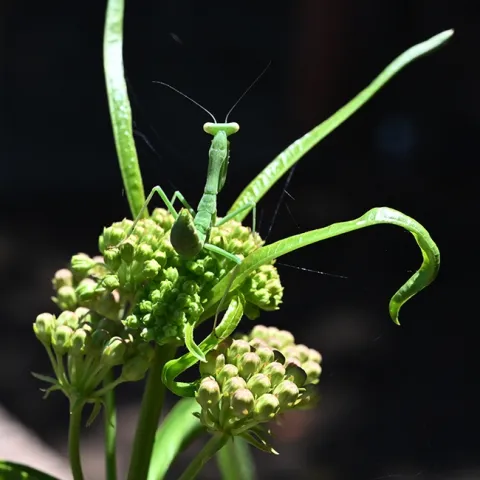
A camouflaged praying mantis, a Stagmomantis limbata, perched on a narrow-leafed milkweed, Asclepias fascicularis. (Photo by Kathy Keatley Garvey)
Bug Squad: Article

A Mantis on the Milkweed

June 26, 2024
By Kathy Keatley Garvey
So here's this immature praying mantis, a Stagmomantis limbata, perched on a narrow-leafed milkweed, Asclepias fascicularis, in a Vacaville pollinator garden. She's camouflaged quite well. She's as green and thin as the leaves. Me: "Hey, Ms. Mantis, whatcha doin'?" Ms.
View Article
UC Cooperative Extension - Madera County: Article

Carpophilus information session July 9

June 26, 2024
Are you interested in learning more about Carpophilus truncatus, the beetle pest of almonds and pistachios that was found in the state last year? Come learn from experts from Australia! July 9 from 3 - 6 PM. The meeting will be held for free over Zoom, but pre-registration is required.
View Article