What to Do Off-Season in the Edible Garden

Putting the garden to rest
Thanks to Marin's mild winter weather, home gardeners can grow vegetables year-round. But you may choose to give the garden (and yourself) some rest and rejuvenation once you've harvested your last summer-fall crop. Here are two options for putting the edible garden to bed before you kick back in your easy chair and flip through seed catalogs.
Two basic options for your edible beds:
> Grow cover crops
> Straw-covered manure layer
Option one: GROW COVER CROPS

Cover crops are plants grown primarily to improve soil. Planted when traditional garden crops are not present, they enrich soil and provide numerous other benefits. Cover crops are often referred to as a “green manure.”
Advantages
• Build soil fertility
• Increase soil organic matter
• Suppress weeds
• Protect soil from wind and water erosion
• Provide habitat for beneficial insects and earthworms
• Loosen soil without digging, as roots reach down deeper than any shovel
• Fix nitrogen in the soil. Research shows that legume crops, especially vetch, are the best for nitrogen fixing.
• Suppress some harmful soil-dwelling nematodes: Mustard plants do this naturally.
• Provide aesthetic addition to winter gardens.
Disadvantages
• May require watering, at least until fall rains keep soil evenly moist.
• Cutting down the crop and digging it into the garden bed is work.
• Patience is required while the chopped material breaks down in the planting bed. Alternatively, put greens in the compost pile.
TIMING: when to plant and cut down a cover crop
Planting cover crop seed at the right time is important for success.
September or October: Sow cover crop. To enhance the soil for spring edibles, avoid planting cover crops after November.
February or early March: When cover crops are 25-50% in flower, cut them down, chop them up, and dig the greens into the soil 3 to 6 weeks prior to planting. The buried material will decompose and provide nutrients and organic material to the soil while increasing biological activity, water infiltration, and soil tilth. Shredded cover crop may also be added to your compost pile instead of digging it into the bed.
Example: Plant cover crop on October 1, cut down on March 1, plant tomatoes and other spring crops on April1-15.
Any time of year: Plant a cover crop at any time to enhance a tired bed, as long as the crop planting is consistent with the growing season.
HOW TO PLANT a cover crop:
• Inoculant: Some UCCE (University of California Cooperative Extension) Farm Advisors recommend inoculating legume seeds prior to planting to effectively fix nitrogen. Legumes work with bacteria called Rhizobium that live on their roots, and allow the plant to fix nitrogen into the soil. Buy inoculant where you buy cover crop seeds.
• Planting depth is based on seed size. In general, the larger the seed, the more soil cover it requires. Follow instructions on seed package and the suggestions below.
• Rake the soil smooth, removing any significant debris from a previous crop.
• Broadcast the seed at the recommended rate for the plant type.
• Cover the seed with soil to the recommended depth for the plant type.
• Water if necessary and keep moist until rains begin.
WHAT TO PLANT
Choose a cover crop based on your goals:
Improve soil structure
Plant deeply rooted plants and/or plants with large biomass such as barley, rye, and daikon radish.
Build soil microbial biomass
(fungi, bacteria and other microbes): Plant Phacelia.
Protect the soil from erosion
Plant grasses, mustard, and radish.
Suppress weeds
Plant grasses, mustard, and radish.
Attract beneficial insects
Plant mustard and radish.
(These plants may also attract undesirable insects such as cucumber beetles and stink bugs).
Increase nitrogen
Plant vetch and other legumes.
Seeding for the season
Common Cover Crops for California are included in the chart below. Once you’ve identified the desirable crop, check with local nurseries or online seed suppliers for availability.

Option two: LAYER OF MANURE COVERED WITH STRAW

A rice straw-covered layer of manure is another way of boosting soil.
Advantages
• Works slowly over the winter to enrich soil
• Attracts earthworms
• Feeds legion of beneficial microbes needed for healthy spring crops
• One-and-done deal; there is nothing to cut down in spring like there is with a cover crop.
Disadvantages
• Sourcing, transporting, and shoveling manure
• A smelly wait for a couple of days for the barnyard aroma to dissipate
HOW TO LAYER IT UP
• Pile on 2 or more inches of herbivore-generated manure (horse, chicken, cow, goat, llama and rabbit are all equally good (preferably from animals that have not been treated with antibiotics or other pharmaceuticals).
• Top it with a fluffy layer of rice straw (often available inexpensively at horse or farm supply stores) or dry leaves three times as deep as the manure layer. The straw stays neat-looking for months, and thick layers of organic material smother most weeds.
• Winter rains keep the pile moist, attracting earthworms and helpful decomposers.
• Straw and leaves hold in moisture and prevent rain from compacting the soil.
• In spring, turn the composted manure and straw into the top layer of soil before planting.
BACK TO EDIBLES
> What Edible Gardens Need
> Best Choices for Marin
> How to Prepare
> How to Plant
> Edibles in Containers
> Planting Calendar
> Grow & Care Sheets for Vegetables, Herbs & Fruits
> Tips & Techniques
> How to Maintain
> Fruit Trees
> Top 20 Edible Garden Problems
> Cover Crops & Soil Enhancements in the Off-season
> Conserving Water
•••••••••
Visit our EDIBLE DEMO GARDEN at IVC Organic Farm & Garden
May 2024: Flowers and Edibles Make Good Neighbors


A variety of flowers are grown in the Edible Demo Garden. Some are perennials such as yarrow and lavender. Others are annuals that are grown from seed in the greenhouse and planted each year. These include zinnias, marigolds, and calendula. Then there are the flowering plants that self-seed and return on their own like the California poppies and the sunflowers. Sunflowers have been so successful in the Edible Demo Garden, that they sometimes show up where they are not wanted.
Favorite flowers for attracting pollinators

Flowering plants that discourage pests
There is increasing scientific-based evidence that certain plants are effective in managing pests in an edible garden. They can confuse pests, luring them away from their favorite target and disrupting their feeding and egg-laying behaviors. Studies have suggested that plants with strong odors can discourage pests by masking the scent of the desired host plant. Marigolds (Tagetes) have long been a pest-repelling favorite of gardeners, but the supporting science is scant. However, there is research showing their effectiveness against parasitic nematodes and some flies affecting vegetable crops. In addition to their ability to attract pollinators, Nasturtiums (Tropaeolum majus), have been found to reduce squash bug damage when grown with zucchini. Their edible flowers make them especially welcome in the garden.
The importance of diversity in the garden
Mixing in some flowering plants with the edibles encourages beneficial insects that can keep pests in check. Members of the Asteraceae family, which includes yarrow, sunflowers, zinnias, calendula, and asters, support beneficial insects that dine on aphids. Flowering herbs provide nectar for parasitic wasps which help control caterpillar pests. Low -growing flowering plants such as thyme and oregano provide a sheltered habitat for ground-dwelling beneficials.
The right flowers in an edible garden are not just ornamental, they balance the garden. They help in creating a habitat that supports plant growth and production and reduces the need for pesticides and other pest-management strategies.
Click here for more information about plants that attract pollinators.
April 2024: The Importance of Soil Testing


However, soil can look and feel healthy, and still be lacking nutrients essential for optimum plant growth. Plants suffering from malnutrition look unhealthy and show symptoms of deficiency. Growth may be stunted, leaves may be chlorotic (yellowed) or distorted, and shoots appear short and thin. Too little or too much of any one nutrient can cause problems. The best way to check for a lack of nutrients in the soil is to test a sample.
How are the nutrient components of soil tested?

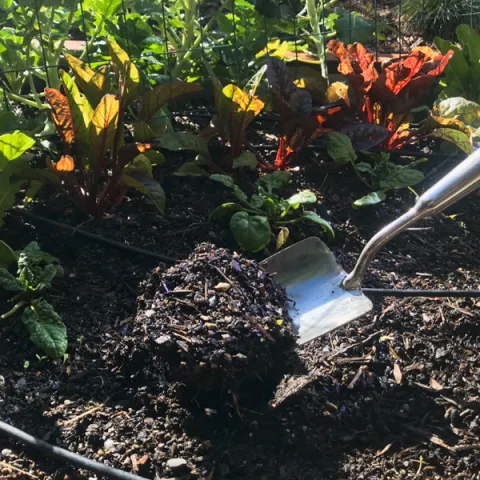
Any soil test should start with a carefully collected soil sample. Use a stainless-steel trowel or shovel to obtain a sample at least six to eight inches below the soil surface. Avoid wet soil, if possible, the sample needs to be dry for testing. Taking samples from several places in a garden bed and mixing them can be useful in measuring overall chemical properties. However, samples from different garden areas (vegetable, perennial, lawn, etc.) should be kept separate. Soil testing laboratories generally provide specific instructions on sample collection.
Why does soil pH matter?
Nutritional elements in the soil need to be in a soluble chemical form to be absorbed by plant roots. There must be sufficient moisture in the soil to allow the roots to take up and transport the nutrients. The temperature of the soil also needs to fall within a certain range for uptake to occur. Finally, the solubility of the nutritional elements and the activity of the microorganisms responsible for the chemical transformation of nutrients are directly influenced by soil pH. An essential nutrient can be present in the soil, but not in a form the plant can use. Each nutrient has an ideal pH range for plant availability. At pH levels that are too acidic or alkaline, some nutrients can become insoluble and not accessible to plant roots. Phosphorus, calcium, and magnesium are elements that become less accessible as soil increases in acidity, while the availability of iron, zinc, and manganese is reduced in more alkaline soils. The ideal pH for most plants is between 5.5 and 7.5.
What nutrients are commonly lacking in soil?

For more information on assessing soil health, click here.
For hands-on practice in soil testing come to the workshop co-sponsored by the Edible Demo Garden and the Edibles Guild. Click here to register.
January 2024: Planting Time for Artichokes


What is an artichoke?
Artichokes are large plants in the sunflower family (Asteraceae). The edible parts are the large flower buds that form on the tops of tall stalks. The buds are typically green, but some varieties are violet-tinged. Buds that are not harvested for cooking and eating will open into attractive purple thistlelike flowers.
Although some may consider artichokes exotic and too much trouble to eat, they have been enjoyed since Roman times. Italian immigrants brought artichokes to Monterrey County where they grew well in the Mediterranean like climate. When artichokes first became popular in the US there was a problem meeting the demand and there are stories of a Mafia attempt to corner the market. Fortunately, we can now have all the artichokes we want to eat when they are in season.
What artichoke varieties grow well in Marin?

Are Artichokes Annuals or Perennials?
In California artichokes are commonly grown as short-lived perennials producing both spring and fall crops. After the spring harvest they are cut back to the ground and kept dry to encourage summer dormancy after which they are regrown in the fall for another crop. However, early maturing varieties like ‘Imperial Star’ and ‘Colorado Star’ also work well as annuals when planted in late fall. In the Edible Demo Garden, the two new varieties replaced older plants that had aged past their prime and suffered some gopher damage.
How to Grow and Harvest Artichokes

The buds on the artichoke plant are ready to harvest just as the lowest bracts begin to open. Once a bud opens more fully, the tenderness and flavor diminish. Harvesting the top bud stimulates the lower buds to develop. Buds should be harvested by cutting the stem about 2 inches below the bud.
For more information on growing artichokes, click here.
December 2023: Caring for the Soil

After the fall harvest was over, it was time to clean up and replenish the soil in the Edible Demo Garden. Healthy soil is fundamental to the success of the next season’s crops. Even in beds that are temporarily fallow, the soil needs to be nurtured and protected. In November, volunteers were busy with three major soil-boosting activities - spreading compost, adding mulch, and planting cover crops.
Why add compost?
The value of compost cannot be overestimated. Most edible crops are heavy feeders and leave the soil depleted of nitrogen and other essential nutrients after they are harvested. Adding a layer of compost to the soil is an earth-friendly way to help restore those nutrients and support good soil structure. Since compost is decomposing organic matter, it needs time to make the nutrients available to plants. In the Edible Demo Garden, compost is applied to all the garden beds prior to planting the next season’s crop.
What is the purpose of mulch?

In late fall, Edible Demo Garden volunteers take apart the straw bales used to grow warm season vegetables. The used straw becomes recycled mulch. Initially, the straw was considered suitable as compost material, however, subsequent testing found it to be low in nitrogen. Although much nitrogen was added to the bales during the growing season, most of it was either taken up by the plants or washed out by watering and rain.
Why plant cover crops?

For several years Edible Demo Garden volunteers have been cultivating a large garden area known as “the back 40”. Planting a cover crop of fava beans in the fall is one of the strategies for improving the poor soil in that area. Before the fava beans could be planted in November, some light tilling of the soil was necessary to improve the penetration and decomposition of the four wheelbarrows full of compost spread by the volunteers. Prior to planting, the bean seeds were soaked in an inoculant containing rhizobacteria to maximize their nitrogen fixation effects.


Paying careful attention to spacing and depth requirements, 150 inoculated fava bean seeds were planted in the back 40 by the volunteers. Some watering will be necessary until the rains begin, but a good crop of green manure should be available to nourish the soil in the spring.
For more information on building healthy soil, click here.